 Wrist
Goodyear welt, Blake stitch or cemented: repair and price
Every product page in our boots and dress shoes edit uses one of three words for how the sole is attached, and that word predicts the shoe's lifetime cost better than the price does. Goodyear welt means the sole is stitched to a strip and can be replaced. Blake stitch means the sole is sewn straight through the insole and can usually be replaced by a shop with the right machine. Cemented, or injected, means the sole is glued or moulded on and is normally replaced along with the shoe. This note explains each method from published sources, then shows what the four makers we have reviewed say about their own construction and what a resole costs where a price exists. Pages were read on October 16, 2026.
Start with the question the product page is answering
A shoe has three layers that matter here: the upper, the insole your foot stands on, and the outsole that touches the ground. Construction is the method of joining them. The method decides whether a worn outsole can be cut away and a new one attached without destroying the upper.
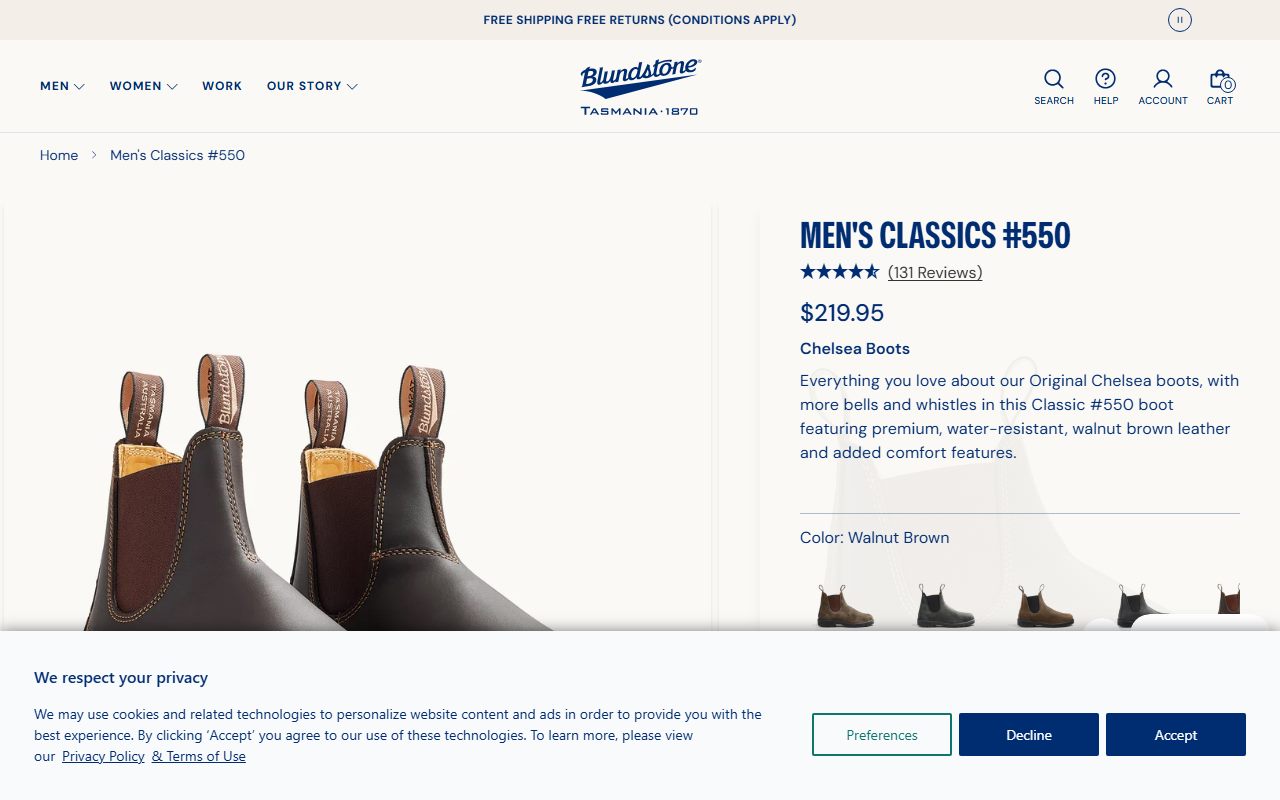
Makers rarely say cemented on a product page. They describe the outsole material, the footbed and the comfort system and leave the attachment unstated. Blundstone's 550 page lists a TPU outsole and an XRD footbed; the sentence about liquid polyurethane injected into a mould lives on the support site. Read both before deciding a shoe is repairable.
Goodyear welt: a strip of leather carries the stitches
In a Goodyear-welted shoe the upper is shaped over a last, then a welt, a strip of leather or synthetic, is stitched to the upper and to a ridge on the insole. The cavity inside the welt is filled, usually with cork, and the outsole is stitched to the welt. The outsole is attached to the welt, not to the upper.
That is why the sole can be replaced repeatedly: a cobbler cuts the outsole stitches, removes the sole and sews a new one to the same welt. Wikipedia's account of the method dates the machine to patents in 1862 and 1869 developed under Charles Goodyear Jr., and notes that resoling remains possible as long as the upper is viable.
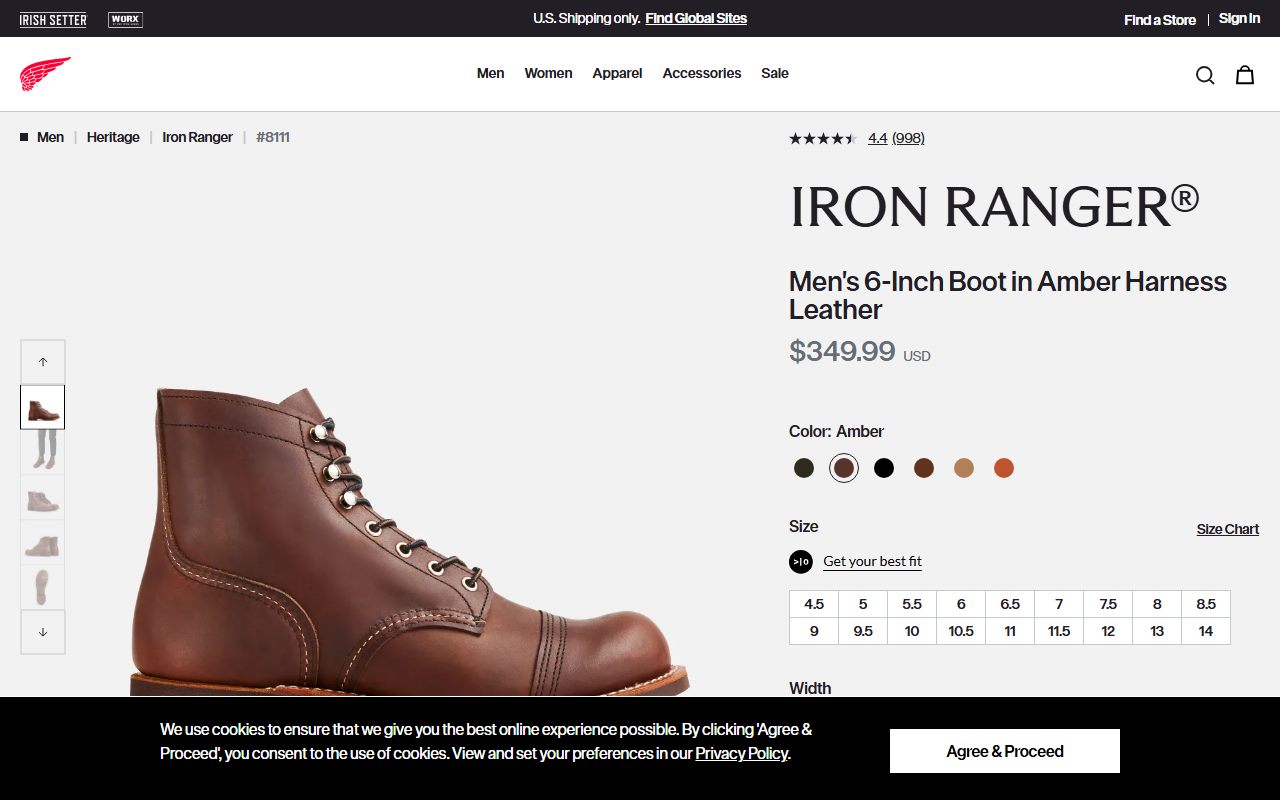
- Red Wing Iron Ranger: Goodyear leather welt, steel shank, leather insole, cork midsole, per the product page. Red Wing resoles it in-house.
- Thursday Captain: Goodyear welt construction, cork-bed midsole, per the product page. Thursday's FAQ says men's boots are resoleable and points to a cobbler list.
- Grant Stone Cap Toe Oxford: Goodyear welt with a 270-degree flat welt, vegetable-tanned leather insole, welt and outsole, cork filler, steel shank, per the product page.
The welt angle is a detail worth knowing. A 360-degree welt runs all the way around and shows a stitched ledge at the heel; a 270-degree welt stops at the heel for a cleaner profile, which is why the dress oxford in our edit specifies it and the boots do not. Both are resoleable.
Blake stitch: one seam, straight through
In a Blake-stitched shoe there is no welt. The upper is wrapped under the insole and a single seam runs through the outsole, the upper and the insole from inside the shoe. The result is a thinner, more flexible sole with a close-cut edge, which is why the method is common on Italian dress shoes and loafers.
The machine that made it practical was patented by Lyman Blake in 1856 and improved by 1864, after which it was sold through his partner McKay; Blake and McKay construction are the same family for this purpose, per Wikipedia's shoemaking article.
Blake shoes can be resoled, but the stitch is inside the shoe, so the cobbler needs a Blake machine rather than the more common welt-stitching equipment. Thursday's FAQ lists Blake Stitch among the constructions it calls resoleable. Fewer local shops can do it, and the insole is pierced by every resole, which limits the count.
Cemented and injected: glued or moulded on
Cemented construction bonds the outsole to the upper with adhesive. Injection moulding goes a step further: liquid sole material is injected into a mould around the lasted upper and cures in place. Wikipedia's shoemaking article dates the first glued-shoe process to 1910. Both are faster and cheaper than stitching, and both produce a lighter, softer sole unit.
Blundstone describes its own method plainly on its support site: most soles are applied using a liquid injection of polyurethane compounds into a mould which is then applied to the leather upper, and the footwear can often not be resoled successfully. The company points buyers who want a replaceable sole to its Goodyear-welted Heritage Series instead.
That candour is unusual and useful. The same support site excludes air bubbles within the sole from warranty as a natural feature of the moulding process, which tells you something about the method that the product page does not. Our Blundstone 550 review covers what the Classics do and do not offer.
What a resole costs when a maker prints a price
Only one maker in our edit publishes a resole price. Red Wing's repairs page lists a resole at $165 including oiling and new laces where applicable, a heel-only replacement at $60 and a Premium Repair Package at $180 that adds minor stitching, hardware repair and leather reconditioning, as of October 16, 2026. Red Wing notes prices may vary by store and offers a free shipping label for services over $50.
Thursday and Grant Stone publish no resole service and no price. Their shoes are resoleable by construction, and the cost is whatever a Goodyear-capable cobbler quotes. Blundstone publishes no price because it does not recommend the repair.
The arithmetic that follows is ours, from published prices. A Red Wing Iron Ranger at $349.99 plus one $165 resole is $514.99 for two sole lives with the upper still in service. Two Blundstone 550s at $219.95 are $439.90 for two sole lives and two uppers. A Thursday Captain at $199 plus a cobbler's quote is the cheapest path if the quote is under $150.
How to read a product page for construction
- Look for the attachment word. Goodyear welt, storm welt, stitchdown, veldtschoen and Blake are stitched and resoleable. Cemented, bonded, injected and vulcanised are not, as a rule.
- If no attachment word appears, assume cemented until the maker says otherwise, and check the support site or FAQ, which is where Blundstone's answer lives.
- Check the insole material. A leather insole over cork, as on the Iron Ranger and the Grant Stone oxford, is the layer that takes a footprint and survives a resole. A removable foam footbed, as on the 550, is a comfort part, not a structural one.
- Look for a repair price or a cobbler list. A printed price, as on Red Wing's repairs page, is the strongest signal that the maker expects the shoe to be resoled.
- Read the warranty for what it excludes. Sole wear is excluded everywhere; sole separation is a defect claim on a cemented shoe and a resole on a welted one.
Where that leaves the four shoes in the edit
The Red Wing Iron Ranger is welted and backed by a printed resole price and a 12-month defect warranty. The Thursday Captain is welted at $199 with no warranty and no maker resole. The Grant Stone Cap Toe Oxford is the most fully specified welt of the three, with a leather sole, no warranty and a 15-day return window. The Blundstone 550 is injected and, by its maker's account, not built to be resoled.
None of that is a verdict on comfort or looks, which this publication does not test. It is a reading of what each maker says about how the sole is attached, and what that costs when the sole wears through. Our published method explains the limits of that approach.
Bottom line
If you want to resole, buy a shoe whose product page uses the word welt or Blake, prefer a maker that prints a repair price, and budget $165 for a maker-run resole or a cobbler's quote for the rest. If you are happy to replace the shoe when the sole goes, a cemented or injected boot is cheaper on day one and often softer, and Blundstone will tell you exactly that if you ask its support site. Either way, read the attachment word before the price. The rest of the boots and dress shoes edit and our buying guides apply this test to every entry.
Frequently asked
Is a Goodyear welt always better than Blake stitch?
Not always. Goodyear welting is more water resistant and easier for most cobblers to resole; Blake stitching is lighter, more flexible and closer-cut. Both are resoleable. The right one depends on whether you want a sturdy boot or a sleek dress shoe.
Can a cemented shoe ever be resoled?
Sometimes a shop will glue a new sole on, but Blundstone says the result may not match the original and most makers do not support it. Treat a cemented or injected shoe as a replace-when-worn purchase and price it accordingly.
How much does a resole cost in 2026?
Red Wing's published price is $165 for a resole and $180 for its full repair package as of October 2026. Thursday, Grant Stone and Blundstone publish no resole price. Independent cobbler quotes vary by region and sole type and are not published by any maker in our edit.
Sources
- Wikipedia: Goodyear welt - checked October 16, 2026
- Wikipedia: Shoemaking (Blake and McKay machine, glued shoes) - checked October 16, 2026
- Blundstone US support: Are Blundstones resoleable? - checked October 16, 2026
- Red Wing repairs and resole pricing - checked October 16, 2026
- Thursday Boot Company FAQ (constructions and resoling) - checked October 16, 2026
- Grant Stone Cap Toe Oxford product page - checked October 16, 2026