 Wrist
How to read a watch spec sheet before you buy

A watch spec sheet answers three questions if you know where to look: can it get wet, what strap will fit, and will it fit you. The trouble is that makers answer them differently. Casio cites an ISO standard and a bar figure; Timex gives metres and an activity list; Seiko and Citizen print bar figures and explain them in a manual. This note walks through the three rows, water resistance, lug width and case size, using the four everyday watches we read on October 16, 2026: the Casio G-Shock GA2100-1A1, the Citizen Promaster Diver BN0150-28E, the Seiko 5 Sports SRPD55 and the Timex Marlin Automatic 40mm. Everything here is read from the makers' pages and manuals; we do not wear or test watches.
Read the water resistance row as an activity list, not a depth
The number on the dial is a test pressure, not a diving depth. Casio's European technology page, read October 16, 2026, says Casio's water resistance follows DIN 8310 and ISO 22810, and adds that metre indications are merely a pictorial representation of the test pressure, so a watch cannot be used at that depth.
The same Casio page explains why: the rating is static pressure, and a hard swimming stroke or a slap on the water produces dynamic pressure many times higher. It also says seals age, so the rating is not permanent.
Every maker turns the pressure into activities, and the lists mostly agree. Here are the four we read, in the makers' own words:
- Casio (Europe page): Water Resistant, splashes and rain only; 5 bar adds bathing and showering; 10 bar adds swimming and snorkelling; 20 bar adds free diving without equipment
- Seiko (4R-caliber manual): WATER RESISTANT with no figure, everyday contact and no swimming; 5 bar, sports such as swimming; 10 or 20 bar, diving not using an air cylinder
- Citizen (Eco-Drive manual): 3 atmospheres, occasional splashing; 5 atmospheres, swimming but not skin diving; 10 or 20 atmospheres, skin diving but not scuba or saturation diving
- Timex (ratings page): 30 m, washing hands; 50 m, light swimming; 100 m adds snorkelling, poolside diving and surfing; 200 m adds recreational scuba
Notice the units. Casio, Seiko and Citizen write bar or atmospheres; Timex writes metres. One bar is roughly one atmosphere and the industry convention is 10 m per bar, so 5 bar reads as 50 m and 20 bar as 200 m. Citizen's manual says the unit 1 bar is roughly equal to 1 atmosphere.
Notice too that only Casio cites the standard on the page we read. Seiko and Citizen use the same tiers in their manuals without naming ISO 22810, and Timex adds that it sells only water-resistant watches, never waterproof ones. A diver's watch standard, ISO 6425, is a separate thing; none of the four pages we read claims it.
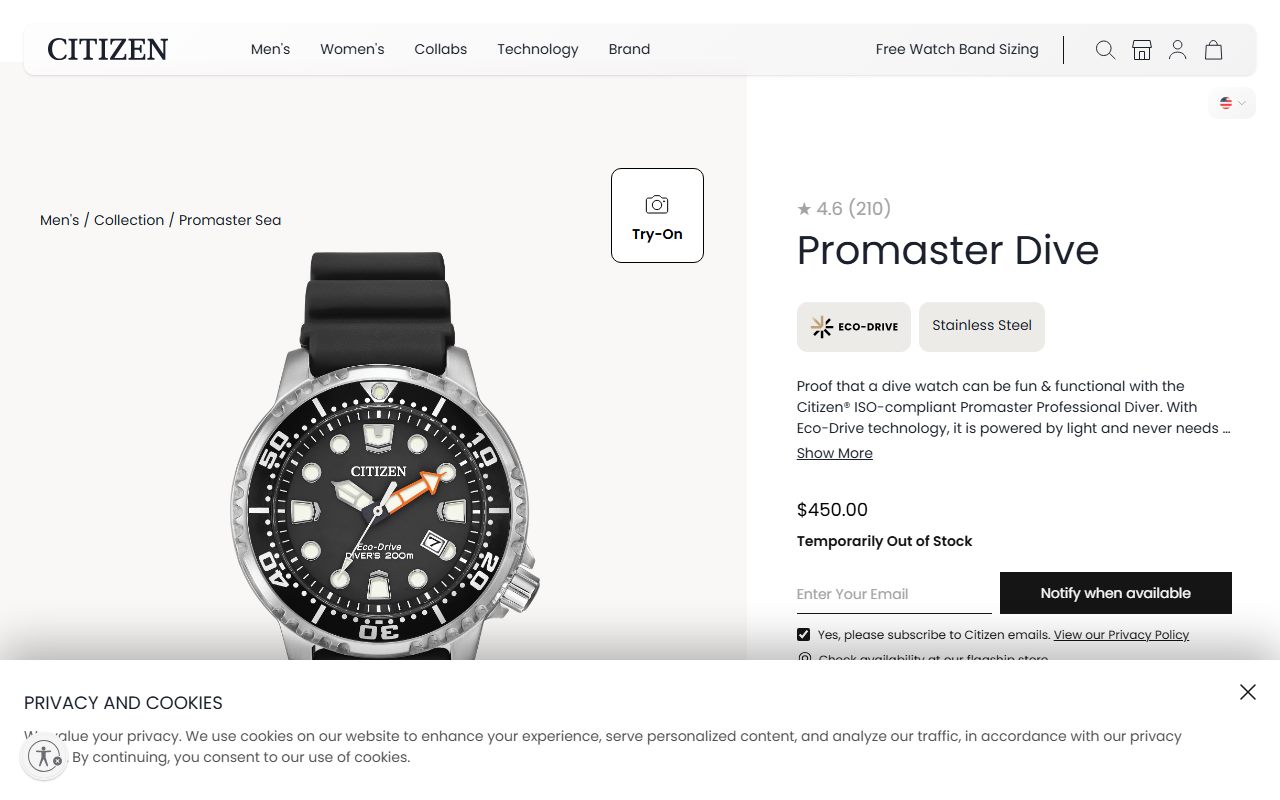
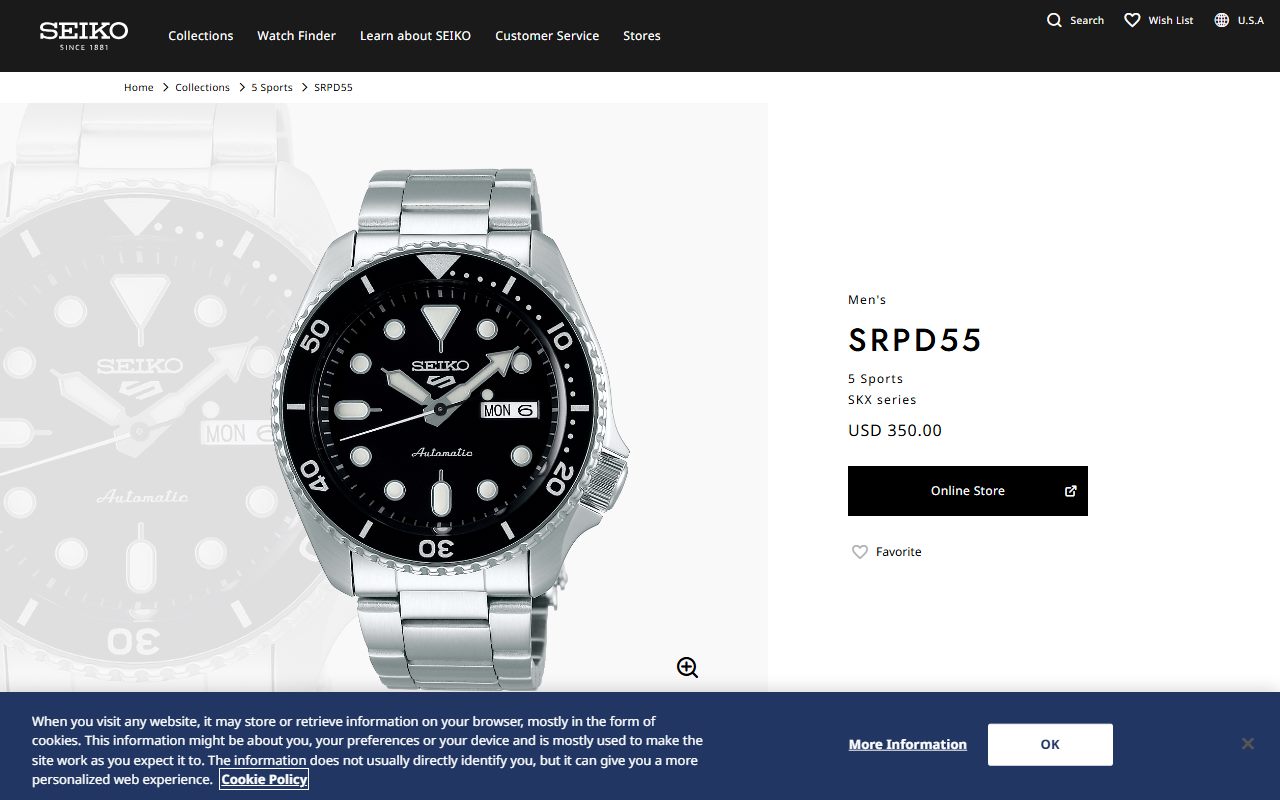
Applied to our four: the Casio GA2100-1A1 and the Citizen BN0150-28E are 20 bar, the Seiko SRPD55 is 10 bar, and the Timex Marlin Automatic is 50 m. By the makers' lists, the first two swim and snorkel, the Seiko swims, and the Timex washes hands and swims lightly.
Check the handling rules that come with the rating
The rating assumes the case is closed. Citizen's manual says to keep the crown pushed in, or screwed down on screw-lock crowns, and not to operate the crown or buttons when wet. Timex's product page says not to press buttons under water unless the watch is rated 200 m.
The rating also assumes the seals are new. Citizen's warranty text requires water-resistant models to be tested and resealed every two to three years. Casio says extreme temperatures, solvents and cosmetics make seals brittle, and recommends about 10 to 50 degrees C.
One more rule from Citizen's manual applies to any watch: rinse after sea water, do not pour tap water directly on it, and take it off before a bath or sauna. A 20 bar label does not change any of that.
Read lug width as the strap size, and check whether it is a standard one
Lug width is the gap between the two lugs where the strap attaches, in millimetres. It tells you which replacement straps fit. Seiko prints Distance between lugs 22 for the SRPD55; Citizen prints Lug Width 20mm for the BN0150; Timex prints Band / Lug Width 20 mm for the Marlin.
Those are standard sizes. 18, 20 and 22 mm straps are stocked everywhere, and a watch with one of those widths and ordinary spring bars can wear anything from a rubber strap to a steel bracelet.
The exception is the integrated band. Casio's GA2100 sheet prints no lug width at all; instead it gives a compatible band size of 145 to 215 mm, which is the wrist circumference the stock resin band closes around. The band is a model-specific fitting, and a standard strap needs an adapter Casio does not document.
So when a sheet shows a band size range instead of a lug width, read it as: this watch takes its own band. When a sheet shows nothing at all, as some makers' pages do, assume the same until you can measure.
Quick-release spring bars are a separate line. None of the four sheets we read mentions them, so changing straps on any of these means a spring-bar tool or a store.
Read case size as three numbers, and refuse to buy on one
Diameter is the number everyone quotes and the least useful alone. Two 42 mm watches can wear completely differently depending on how far the lugs reach and how tall the case is. The three numbers that matter together are diameter, lug-to-lug and thickness.
Lug-to-lug is the distance from the tip of the top lug to the tip of the bottom lug. It decides whether the watch overhangs the flat of your wrist. Seiko prints Lug-to-lug 46.0mm for the 42.5 mm SRPD55. Casio prints its case as 48.5 x 45.4 x 11.8 mm, where 48.5 is the lug-tip length and 45.4 the width.
Citizen prints Case Width 44mm for the BN0150 and nothing for lug-to-lug or thickness. Timex prints Case Diameter 40 mm and Case Height 13 mm for the Marlin and nothing for lug-to-lug. Those are gaps in the makers' sheets, and we leave them as gaps rather than estimating.
Thickness decides cuffs and knocks. The four we read run 11.8 mm for the Casio, 13 mm for the Timex and 13.4 mm for the Seiko, with the Citizen unpublished. A dress-styled automatic at 13 mm is thicker than a sports quartz at 11.8 mm, which the diameters alone would never tell you.
Weight closes the picture. Casio prints 51 g, Timex 56.65 g on leather, Seiko 170.0 g on a steel bracelet, Citizen nothing. A bracelet can triple the weight of a watch head, which is why the strap type sits next to the weight on a good sheet.
Use the movement rows to predict what the watch will ask of you
Spec sheets rarely say maintenance, but the movement rows do. A quartz sheet gives battery life: Casio prints approx. 3 years on two SR726W cells. A solar sheet gives reserve and charge time: Citizen's E168 manual prints about six months on a full charge and 12 hours of direct sun to fill it from empty.
A mechanical sheet gives power reserve and an accuracy band: approx. 41 hours and plus 45 to minus 35 seconds a day for Seiko's 4R36, approx. 42 hours and minus 20 to plus 40 seconds a day for the Timex's Miyota 8215. Both bands are tolerances, not promises, and both watches stop after a weekend in a drawer.
Read hacking and hand winding on a mechanical sheet too. Both the Seiko and the Timex list them, which means they can be set to the second and restarted without shaking.
Read the warranty as exclusions first, term second
The term is the headline: five years from Citizen, three from Seiko USA for purchases from July 1, 2024, one from Casio and from Timex. The exclusions are the contract. Casio's text leaves out the battery, band and case. Citizen's leaves out the power cell, case, strap and bracelet. Seiko's leaves out non-metal bands and requires a dealer-dated card.
So a steel bracelet on a Seiko is covered for three years and a rubber strap on a Citizen is not covered at all. Neither is unusual; both are worth knowing before the sheet convinces you.
Bottom line
Read water resistance as the maker's own activity list and the handling rules that go with it, not as a depth. Read lug width as the strap size, and treat a missing width as a sign of an integrated band. Read case size as diameter plus lug-to-lug plus thickness, and do not buy on diameter alone.
When a maker leaves a row blank, that is information too. Of the four sheets we read in October 2026, Seiko's is the only one that prints every fit figure; Citizen's leaves out the two that matter most on a 44 mm diver. Our best everyday watches under $500 guide ranks the four on exactly these rows, and the Seiko vs Timex comparison puts two automatics' sheets side by side. How we grade is on the method page.
Sources
- Casio Europe, Water resistance (DIN 8310 / ISO 22810) - checked October 16, 2026
- Seiko instruction manual, calibers 4R35 to 4R72, water resistant performance and specifications - checked October 16, 2026
- Citizen Eco-Drive instruction manual, water resistance table and E168 charging table - checked October 16, 2026
- Timex water resistance ratings - checked October 16, 2026
- Casio US product page, GA2100-1A1 - checked October 16, 2026
- Citizen US product page, BN0150-28E - checked October 16, 2026
- Seiko US product page, SRPD55 - checked October 16, 2026
- Timex product page, Marlin Automatic 40mm TW2V44600 - checked October 16, 2026