 Wrist
How to Read a Running Shoe Spec Sheet: Drop, Stack, Width
A running shoe product page gives you three or four numbers and expects you to know what they mean. Drop tells you how much the heel sits above the forefoot. Stack height tells you how much foam is under you. Width letters tell you whether the shoe is cut for your foot at all. This note explains each one in plain terms and then shows what four current daily trainers publish, read from the brand pages on October 16, 2026. The short version: all four publish drop and weight, none publish stack height, and width coverage ranges from one option to four.
Drop is the heel-to-toe height difference, in millimeters
Heel-to-toe drop, also called offset, is the difference between the midsole height under the heel and under the forefoot. A 10 mm drop means the heel sits 10 mm higher than the ball of the foot. A 0 mm drop means they are level.
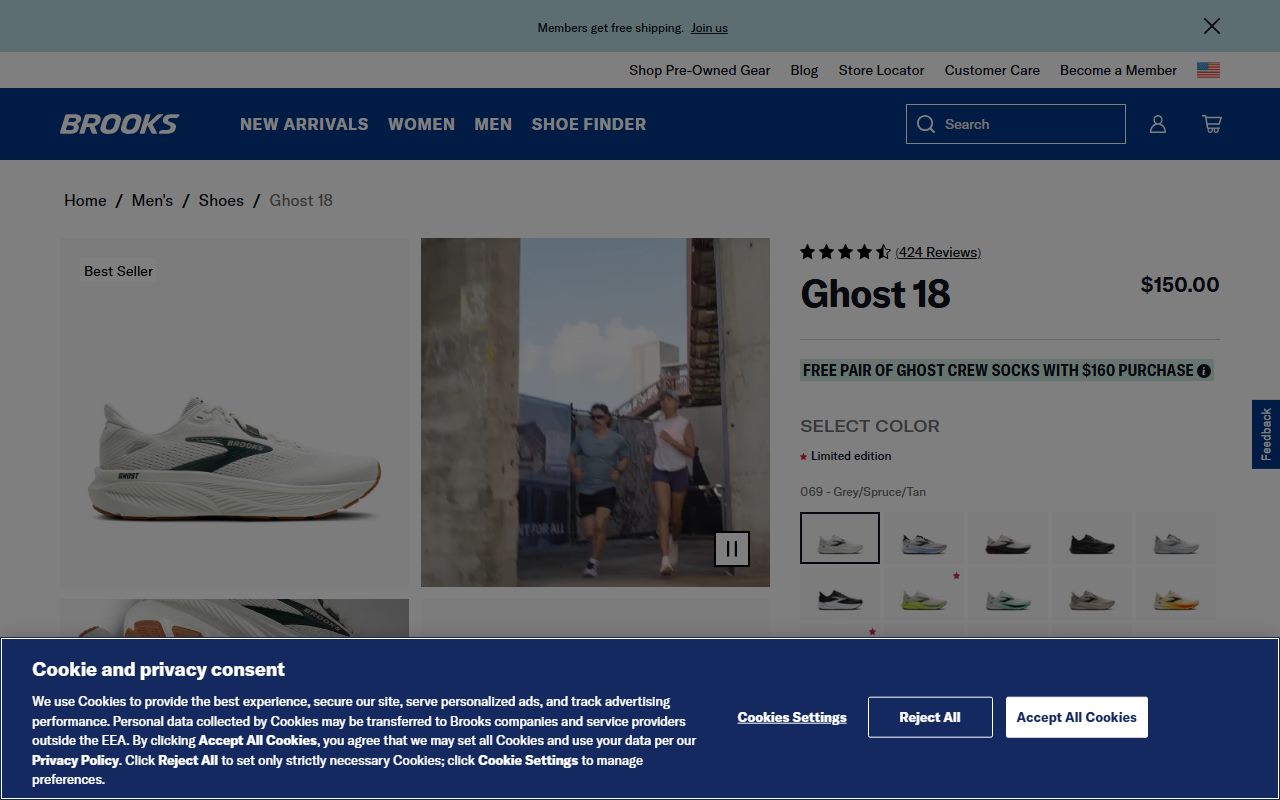
Brands publish this figure almost universally because it is cheap to state and buyers ask for it. Among the four daily trainers we read, the Brooks Ghost 18 lists 10 mm, the Hoka Clifton 11 lists 8.00 mm, the ASICS GEL-NIMBUS 28 lists 8 mm and the New Balance 1080v15 lists 6 mm.
What drop does not tell you is how the shoe feels. Two 8 mm shoes with different foams and different rocker shapes will not behave the same. Drop is a geometry fact, not a comfort rating, and we treat it as one.
The practical use of drop is continuity. If your current shoe is 10 mm and has caused no trouble, a 10 mm replacement asks nothing new of your calves and Achilles. Moving from 10 mm to 6 mm is a change worth making gradually. That is a general principle from running shoe fitting, not medical advice, and anyone with an injury history should ask a clinician.
Stack height is the total foam under your foot, and most brands do not print it
Stack height is the thickness of the midsole plus outsole, usually quoted at the heel and the forefoot. Heel stack minus forefoot stack equals drop. A shoe listed as 38 mm heel and 30 mm forefoot has an 8 mm drop.
This is the number that defines the max-cushion category, and it is the number brands most often leave out. On October 16, 2026, none of the four product pages we read published a stack height: not Brooks, not HOKA, not ASICS, not New Balance. We checked the product pages themselves with a full browser, not search snippets, and the figure was absent on all four.
Third-party review sites often quote stack heights they measured or were given at press launches. We do not import those figures into our spec tables, because we cannot verify the measurement method or the size measured. When a brand publishes stack height, we print it with the date. When it does not, the row says so.
Why does it matter if the brand will not tell you? Because stack height drives two things you can feel: how far your foot sits from the ground, which affects stability on uneven surfaces, and how much foam is available to compress, which affects how the shoe ages. A buyer comparing a Clifton with a Nimbus on paper is comparing two tall shoes with no published height for either.
Width letters are a brand code, not a universal standard
US running shoes use letters for width. For men, D is standard, 2E is wide, 4E is extra wide, and B is narrow. For women, B is standard, D is wide, 2E is extra wide, and 2A is narrow. The same letter means a different width across genders, and the actual millimeters behind each letter vary by brand and by last.
Brands also use words instead of letters. HOKA lists Regular, Wide and X-Wide. Brooks lists Narrow (1B), Medium (1D), Wide (2E) and Extra Wide (4E), which maps the words to the letters for you. New Balance lists Narrow (B), Standard (D), Wide (2E) and X-Wide (4E). ASICS lists Standard on the Nimbus 28 page we read, and sells wide fittings as separate product codes when it offers them.
Here is the width coverage on the four pages we read, as of October 16, 2026:
- Brooks Ghost 18: four widths, 1B through 4E, men's sizes 7 to 15, all at $150
- New Balance 1080v15: four widths, B through 4E, men's sizes 7 to 16, all at $169.99
- Hoka Clifton 11: three widths, Regular, Wide, X-Wide, men's sizes 7 to 16, all at $155; no narrow
- ASICS GEL-NIMBUS 28: one width, Standard, men's sizes 6 to 16, at $170; no wide shown on the listing we loaded
The useful rule is that a width letter only means something inside one brand. If a D in Brooks fits, that tells you little about a D in New Balance. New Balance publishes a per-width centimeter chart on its product page, which is the most honest way we have seen a brand handle this.
Weight is published everywhere, but the reference size usually is not
All four pages publish a weight: Ghost 18 at 10.2 oz (289.2 g) men's and 9.2 oz (260.8 g) women's, Clifton 11 at 9.97 oz, Nimbus 28 at 281 g (9.9 oz), 1080v15 at 261 g (9.2 oz).
Only Brooks separates men's and women's figures, and none of the four states which size was weighed. Running shoe weights are conventionally quoted for a US men's 9, but a brand that does not say so has not promised it. Treat a half-ounce difference between brands as within the noise of unstated sizes.
ASICS adds one useful number the others do not: a stated version-to-version change, approximately 20 g lighter than the Nimbus 27. That is the kind of figure a spec sheet should carry and rarely does.
Foam names tell you what the brand wants to sell, not how soft it is
Three of the four pages name the midsole material. ASICS names FF BLAST PLUS cushioning and PureGEL. New Balance names Infinion, a foam new to the 1080v15 that replaces the Fresh Foam X branding the v14 carried. HOKA describes a compression molded foam without naming it. The Brooks Ghost 18 page we loaded did not name the Ghost's foam; DNA LOFT v3 appeared only in the ad block for the Ghost Max 4.
A foam name is a brand asset. It does not come with a density, a hardness or a durability figure on any of these pages. What it does give you is continuity: if you liked a shoe with a named foam, the next version with the same name is more likely to feel familiar than one that changed it. The 1080v15's rename is a signal that the ride changed.
Return policy is the spec that covers every other spec
Because stack height is missing and width letters are brand-specific, the return policy is the number that matters most for a first purchase. It determines what a wrong guess costs.
- Brooks: 90 days, free return shipping, and the shoes may be run in (Run Happy Promise)
- ASICS: 90 calendar days, but shoes must be unworn; $4.99 deducted for non-member mail returns, free in store and for OneASICS members
- New Balance: 45 days in new condition; $5 restocking fee for non-member online returns, free for members and in store
- HOKA: 30 days for a full refund or exchange, 60 days for free members
ASICS is also the only brand of the four whose pages gave us a manufacturing-defect warranty term to quote: one year on footwear from delivery. If the other three publish one, it was not linked from the product or returns pages we read on October 16, 2026.
A six-line checklist before you buy
- Match the drop to your current shoe unless you have a reason to change it
- If stack height is not published, do not fill it in from a review site; note the gap and rely on the return window instead
- Read width letters inside the brand only; look for a centimeter chart if the brand offers one
- Treat weight differences under half an ounce as unresolved unless the brand states the reference size
- Use the foam name for continuity between versions, not as a softness rating
- Compare return windows and whether the shoe may be worn; that is the real cost of guessing wrong
Bottom line
A running shoe spec sheet is short and the gaps are predictable. Drop and weight will be there. Stack height usually will not. Width will be in letters or words that only mean something inside that brand. Read the four figures, note what is missing, and let the return policy carry the risk the spec sheet will not. Our running shoe reviews print every figure with the date it was checked and leave a row blank rather than estimate, and our editorial policy explains why we never claim to have run in a shoe.
Sources
- Brooks Ghost 18 men's product page - checked October 16, 2026
- HOKA Clifton 11 men's product page - checked October 16, 2026
- ASICS GEL-NIMBUS 28 men's product page - checked October 16, 2026
- New Balance 1080v15 men's product page - checked October 16, 2026
- Brooks returns and exchanges - checked October 16, 2026
- ASICS return policy and warranty terms - checked October 16, 2026
- New Balance return policy - checked October 16, 2026
- HOKA Fly for 30 guarantee - checked October 16, 2026