 Wrist
Best Daily Trainers for New Runners: 4 Spec Sheets, Ranked
Our top pick for a first daily trainer is the Brooks Ghost 18, because it is the cheapest of the four shoes we read at $150, comes in four widths from narrow to extra wide, and can be run in for 90 days and still returned free. This guide is for someone buying their first or second pair of running shoes online, without a specialty store nearby. We graded four current neutral daily trainers on documentation, pricing pages and verified owner reports checked October 16, 2026. We did not run in any of them, and we explain how we picked below.
Our picks
- Best overall for a first pair: Brooks Ghost 18
- Best for a lighter, rockered ride: Hoka Clifton 11
- Best for the lowest drop and narrow feet: New Balance 1080v15
- Best documented spec sheet: ASICS GEL-NIMBUS 28
The best daily trainers for new runners at a glance
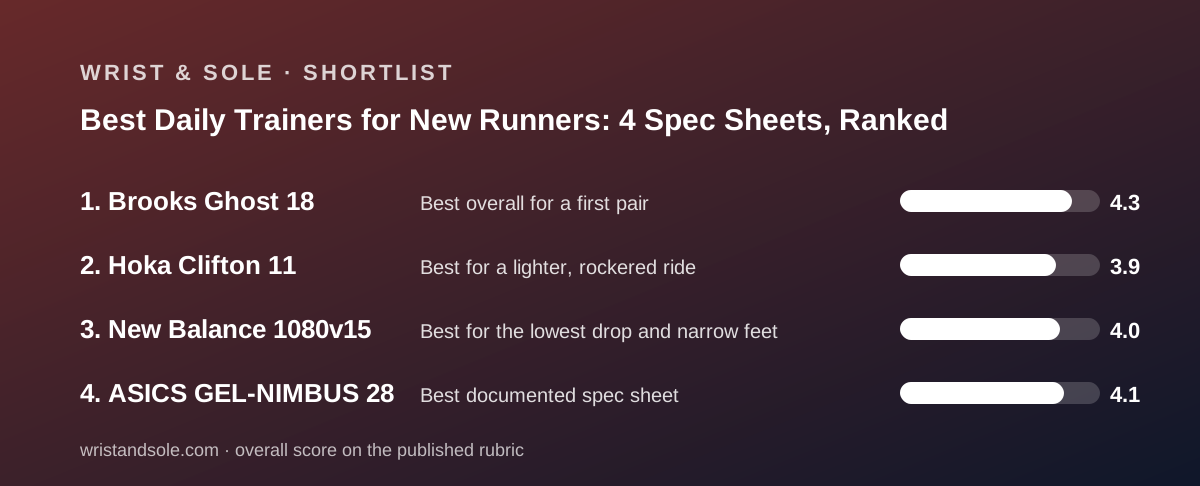
Four shoes, four brand pages, one date. Here is the short list with the reason each one is on it.
- Brooks Ghost 18 - best overall for a first pair: $150, 10 mm drop, four widths, 90-day run-in return window
- Hoka Clifton 11 - best for a lighter, rockered ride: $155, 8 mm drop, 9.97 oz, three widths, 30-day returns
- New Balance 1080v15 - best for the lowest drop and narrow feet: $169.99, 6 mm drop, 261 g, four widths, 45-day returns
- ASICS GEL-NIMBUS 28 - best documented spec sheet: $170, 8 mm drop, 281 g, named foams, one-year defect warranty, one width
Every figure above comes from the brand's own product page on October 16, 2026. None of the four publishes a stack height, which is why that column is missing from this guide and why our spec sheet primer spends a whole section on the gap.
How we picked
We did not run tests of our own; grades come from documentation, pricing pages and verified owner reports checked on October 16, 2026. Four criteria carried the ranking, in this order.
Fit coverage first. A new runner usually does not know their width letter. A shoe sold in four widths at one price gives a first-timer the best odds of a fit without a store visit.
Return terms second. For a buyer who has never run in the shoe, the return window and whether the shoe may be worn are the real cost of a wrong guess. We weighted a 90-day run-in policy far above a 30-day or unworn-only one.
Spec transparency third. Published drop, weight, foam name and warranty let a buyer compare shoes without guessing. Missing stack height counted against every shoe equally, since none published it.
Owner data fourth. The guide uses the brand's own review averages and fit percentages where readable, and we say plainly where they were not. We do not import retailer ratings or search snippets.
Price was a tiebreaker, not a criterion. The spread is $20 across the four shoes, which matters less than the policies behind it.
Best overall for a first pair: Brooks Ghost 18
The Ghost 18 is the shoe to buy when you do not yet know your width or your preferences, and that describes most new runners.
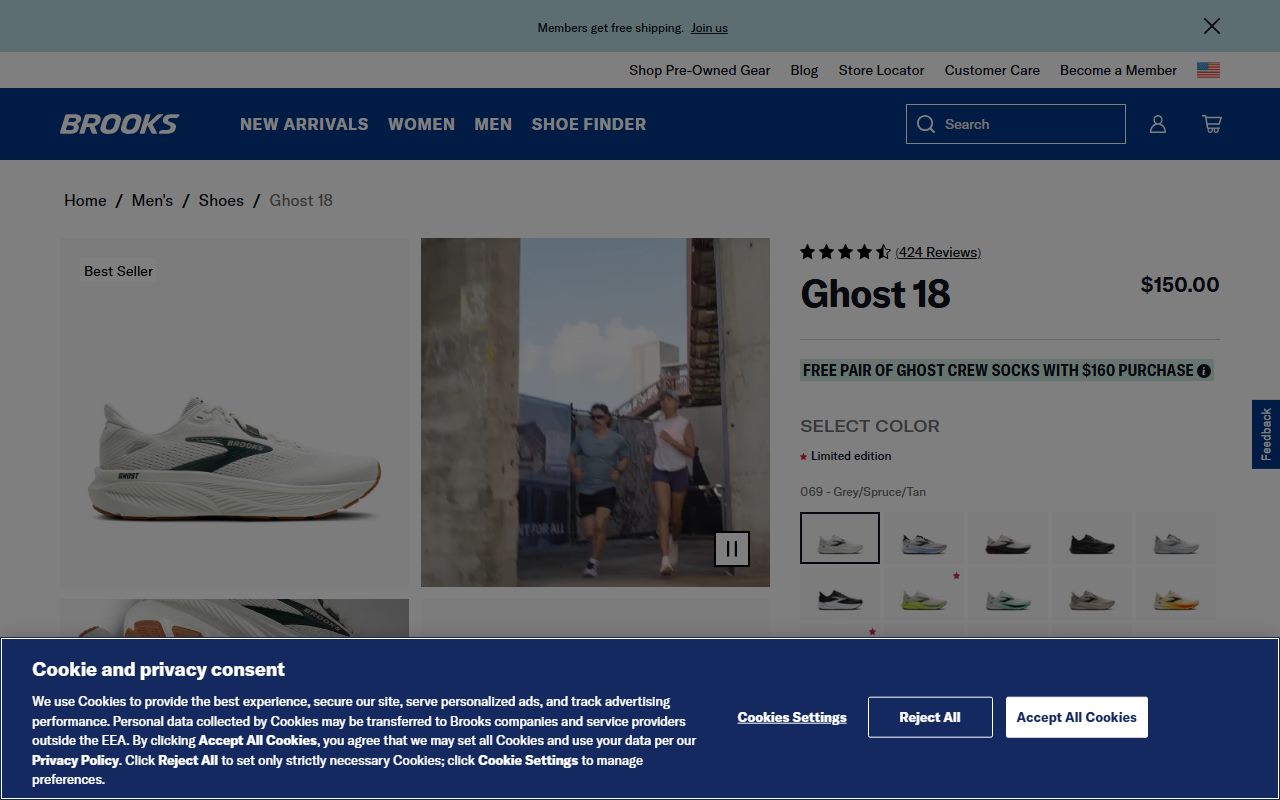
Brooks lists it at $150.00 in Narrow (1B), Medium (1D), Wide (2E) and Extra Wide (4E), US men's 7 to 15 and women's 5 to 13. The drop is 10 mm. Published weight is 10.2 oz (289.2 g) for men and 9.2 oz (260.8 g) for women. The upper is a lightweight mesh with 55.3 percent recycled content, a figure Brooks prints on the page.
Policy is where it wins. The Run Happy Promise gives 90 days to run in the shoe, indoors or out, and return it for a full refund with free return shipping. No other brand here writes running into its return terms.
Owner data is the richest in the group: 4.4 out of 5 from 423 reviews on the men's page, 4.2 from 586 on the women's, and 81 percent of men's reviewers reporting true to size. Brooks' own review summary lists sizing, tongue fit and early tread wear as the minority complaints.
The gaps: no stack height, no foam name on the Ghost 18 page we loaded, and the heaviest published weight of the four. Why it sits at number one: it wins fit coverage and return terms outright, the two criteria that matter most to a first-time buyer, and loses only on weight and documentation. Read our full Brooks Ghost 18 review.
Best for a lighter, rockered ride: Hoka Clifton 11
The Clifton 11 is the pick for a new runner who already knows they want a rockered, lower-drop shoe, usually because a friend or a store once put them in a Clifton.
HOKA lists it at $155.00 in Regular, Wide and X-Wide, US men's 7 to 16, across 18 colors. The drop is 8.00 mm and the published weight is 9.97 oz, with no reference size stated. The feature list documents a Smooth MetaRocker, an engineered mesh upper, an abrasion rubber outsole and a double-lace lock that HOKA says was added to limit tongue migration.
What it does not document: the midsole is described only as compression molded foam, stack height is absent, and the review widget was empty when we loaded the page, so there is no owner rating to report. Returns are 30 days for a full refund, 60 for free members.
Why it sits at number two: it is lighter and cheaper than the ASICS and New Balance options and the geometry is fully stated, but it lacks a narrow width, says less about its materials than either, and gives a first-time buyer 30 days to decide against Brooks' 90. Read our full Hoka Clifton 11 review, and for the direct match-up, Brooks Ghost 18 vs Hoka Clifton 11.
Best for the lowest drop and narrow feet: New Balance 1080v15
The 1080v15 is the choice for a new runner who wants the least heel lift in a mainstream trainer and needs a narrow or extra wide fitting.
New Balance lists it at $169.99 in Narrow (B), Standard (D), Wide (2E) and X-Wide (4E), US men's 7 to 16. The drop is 6 mm and the published weight is 261 g (9.2 oz), the lowest and lightest figures in this guide. The midsole is a new foam called Infinion, which replaces the Fresh Foam X branding the v14 carried; New Balance states its purpose as resisting the compressed, worn-out feel over the life of the shoe. The upper is a perforated mesh.
Owners rate it 4.2 out of 5 from 568 reviews, and New Balance discloses that some reviewers received the shoe free. New Balance also publishes a per-width centimeter size chart on the page, the most useful fit document among the four.
Returns are 45 days in new condition, with a $5 restocking fee for non-member online returns. No defect warranty term appeared on the pages we read.
Why it sits at number three: it matches Brooks on widths and beats everyone on weight and drop, but it costs $20 more than the Ghost 18, allows no run-in returns, and carries the lowest readable owner average. Read our full New Balance 1080v15 review.
Best documented spec sheet: ASICS GEL-NIMBUS 28
The GEL-NIMBUS 28 is the shoe for a new runner who wants the brand to say exactly what they are buying, and who already knows they take a standard width.
ASICS lists it at $170 in Standard width, US men's 6 to 16 with half sizes to 13.5. The heel drop is 8 mm and the weight 281 g (9.9 oz), approximately 20 g lighter than the previous version by ASICS' own statement. The midsole is named as FF BLAST PLUS cushioning with PureGEL, the upper is an engineered knit, and ASICS rates cushion Maximum and support Neutral.
It is the only shoe here whose pages gave us a defect warranty to quote: one year on footwear from delivery, excluding laces and insoles. Owners rate it 4.4 out of 5 from 377 reviews.
Returns run 90 calendar days but shoes must be unworn, unwashed and in original packaging, with $4.99 deducted for non-member mail returns. A wide GEL-NIMBUS 28 did not appear on the collection page we loaded.
Why it sits at number four: its single width on the listing we read and its unworn-only return rule are the two worst outcomes for a buyer who does not yet know their fit, even though its spec sheet and warranty are the best in the group. Read our full ASICS GEL-NIMBUS 28 review.
Also considered
Four shoes came up during research that we did not grade, either because we only saw them in a brand's related-products row or because their pages did not load.
- Brooks Ghost Max 4: advertised on the Ghost 18 page as an ultra-stacked DNA LOFT v3 shoe for maximum protection. We did not read its product page, so price, weight and widths are unverified here; it is the in-house step up if the Ghost 18 is not cushioned enough
- Hoka Rincon 5: shown in HOKA's related-products row at $125 under Everyday Running with 2 widths. We read only that row, not the product page
- New Balance Fresh Foam X 880v15: shown in New Balance's comparison module at $149.99, on sale at $114.99 when we checked, as the lower-priced everyday trainer beside the 1080v15. We did not read its page
- Altra Running: a zero-drop brand that would be the natural fifth entry for a drop comparison. Its product pages did not load in either of our two attempts on October 16, 2026, so no Altra shoe is graded. Altra and Brooks Running both appear in the Impact affiliate marketplace; that had no bearing on this list and no affiliate links appear in it
Brooks Ghost Max 4. Advertised on the Ghost 18 page as an ultra-stacked DNA LOFT v3 shoe; product page not read for this guide.
Hoka Rincon 5. Listed at $125 with 2 widths in HOKA's related-products row; product page not read.
New Balance Fresh Foam X 880v15. Listed at $149.99 in New Balance's comparison module; product page not read.
Altra Running (any model). Pages did not load in two attempts on October 16, 2026; no zero-drop option graded.
How to choose a first daily trainer
Start with width. If you have ever been told you have narrow or wide feet, limit yourself to the two shoes with four widths: the Brooks Ghost 18 and the New Balance 1080v15. If you have never had a fit problem, all four are open.
Then decide how long you need. If you want to run in the shoe before committing, Brooks is the only brand here that writes that permission into its policy. HOKA's 30 days does not require unworn condition but is short. New Balance and ASICS require the shoe to come back new.
Then look at drop relative to what you own. A 10 mm shoe replacing a 10 mm shoe is the quiet choice. A step to 8 mm with the Clifton 11 or GEL-NIMBUS 28 is modest. A step to 6 mm with the 1080v15 is the biggest change in this group, and anyone with an injury history should ask a clinician before making it.
Then weigh the materials disclosure. ASICS and New Balance name their foams. HOKA and the Brooks Ghost 18 page do not. A named foam is continuity between versions, not a softness rating, but it is something.
Finally, read what the brand will not tell you. No stack height anywhere. No defect warranty on three of four. Those blanks are a reason to lean on the return policy, not a reason to trust a third-party number. Every figure in this guide with its source is in the individual reviews in our running shoe section.
Bottom line
A new runner buying online should buy the shoe that is easiest to get right and cheapest to get wrong. On the four spec sheets we read, that is the Brooks Ghost 18: four widths, 90 days of running, $150.
The Hoka Clifton 11 is the right second choice for a known preference for rocker and lower drop. The New Balance 1080v15 and ASICS GEL-NIMBUS 28 are better shoes on paper in specific ways, lightest and best documented respectively, but both ask you to know your fit before you order. Our editorial policy explains why none of this is based on running in them.
What changed
October 16, 2026: first published. Models graded are the versions on sale at each brand on that date: Ghost 18, Clifton 11, 1080v15, GEL-NIMBUS 28. Slugs carry no version number so each entry can be updated in place when the next version ships.
Best overall for a first pair: Brooks Ghost 18
Top pick on our rubric. $150.00, 10 mm drop, 10.2 oz men's and 9.2 oz women's published, four widths from 1B to 4E, and a 90-day return window that allows running. Owner rating 4.4 from 423 reviews, 81 percent true to size. Stack height and foam name are not published on the page we read.
Wins fit coverage and return terms outright; loses only on weight and documentation.
Visit Brooks Ghost 18
We have no affiliate relationship with this vendor. Link goes to the official site.
Best for a lighter, rockered ride: Hoka Clifton 11
$155.00, 8.00 mm drop, 9.97 oz published, Smooth MetaRocker, three widths with no narrow, 18 colors. Midsole unnamed, stack height unpublished, owner rating not readable when we checked. Returns 30 days, or 60 for free members.
Lighter and cheaper than the ASICS and New Balance options, but no narrow width, less materials disclosure, and a 30-day window.
Visit Hoka Clifton 11
We have no affiliate relationship with this vendor. Link goes to the official site.
Best for the lowest drop and narrow feet: New Balance 1080v15
$169.99, 6 mm drop, 261 g published, new Infinion foam replacing the Fresh Foam X name, four widths from B to 4E, per-width centimeter chart. Owner rating 4.2 from 568 reviews including free-product reviewers. Returns 45 days in new condition, $5 fee for non-members.
Matches Brooks on widths and leads on weight and drop, but costs $20 more, allows no run-in returns, and has the lowest readable owner average.
Visit New Balance 1080v15
We have no affiliate relationship with this vendor. Link goes to the official site.
Best documented spec sheet: ASICS GEL-NIMBUS 28
$170, 8 mm drop, 281 g published and stated as about 20 g lighter than the previous version, FF BLAST PLUS and PureGEL named, engineered knit upper, one-year footwear defect warranty. Owner rating 4.4 from 377 reviews. Standard width only on the listing we read; returns 90 calendar days but unworn only.
Best spec sheet and only published warranty, but one width and an unworn-only return rule are the worst outcomes for a buyer who does not know their fit.
Visit ASICS GEL-NIMBUS 28
We have no affiliate relationship with this vendor. Link goes to the official site.
How we chose
We read the official product page, returns page and, where linked, the warranty page for each shoe with a full browser on October 16, 2026, and recorded drop, weight, upper, midsole, widths, sizes, price, return terms and the owner rating shown on the brand's own site. We ranked on fit coverage, return terms, spec transparency and owner data, in that order, with price as a tiebreaker. We did not run in any shoe. Where a brand did not publish a figure, the entry says so rather than borrowing from third parties.
Frequently asked
What is the best running shoe for a beginner in 2026?
On the four brand spec sheets we read on October 16, 2026, the Brooks Ghost 18 is the best first purchase: $150, four widths from narrow to extra wide, a 10 mm drop and a 90-day return window that allows running. The Hoka Clifton 11 is the lighter, rockered alternative at $155.
How much should a new runner spend on daily trainers?
The four current neutral trainers in this guide list between $150 and $170 at the brands on October 16, 2026. The $20 spread buys documentation and policy differences, not a clearly better shoe, so a new runner has no spec-sheet reason to spend above $150 for a first pair.
Should a beginner choose a high drop or low drop shoe?
Continuity matters more than the number. The four shoes here publish 10 mm (Brooks), 8 mm (HOKA, ASICS) and 6 mm (New Balance). A runner replacing an older 10 mm trainer changes least with the Ghost 18; anyone with an injury history should ask a clinician before dropping to 6 mm.
Which daily trainer comes in the most widths?
The Brooks Ghost 18 (1B, 1D, 2E, 4E) and New Balance 1080v15 (B, D, 2E, 4E) each list four widths. The Hoka Clifton 11 lists three with no narrow. The ASICS GEL-NIMBUS 28 listing we read offered Standard only.
Can I return running shoes after running in them?
At Brooks, yes, for 90 days with free return shipping. At HOKA, the 30-day guarantee (60 for members) does not require the shoes to be unworn. New Balance requires new condition within 45 days and ASICS requires unworn within 90 calendar days.
Why does this guide not list stack heights?
Because none of the four brands publishes a stack height on its product page, as checked October 16, 2026. We do not import measurements from review sites whose method and reference size we cannot verify, so the row stays blank until a brand prints the figure.