 Wrist

Apple Watch Series 12
The current Apple Watch read as a running watch: 32.2 g, 2,000 nits, 50 m water resistance, 10 hours of GPS workout and a 24-hour charge cycle, from $399
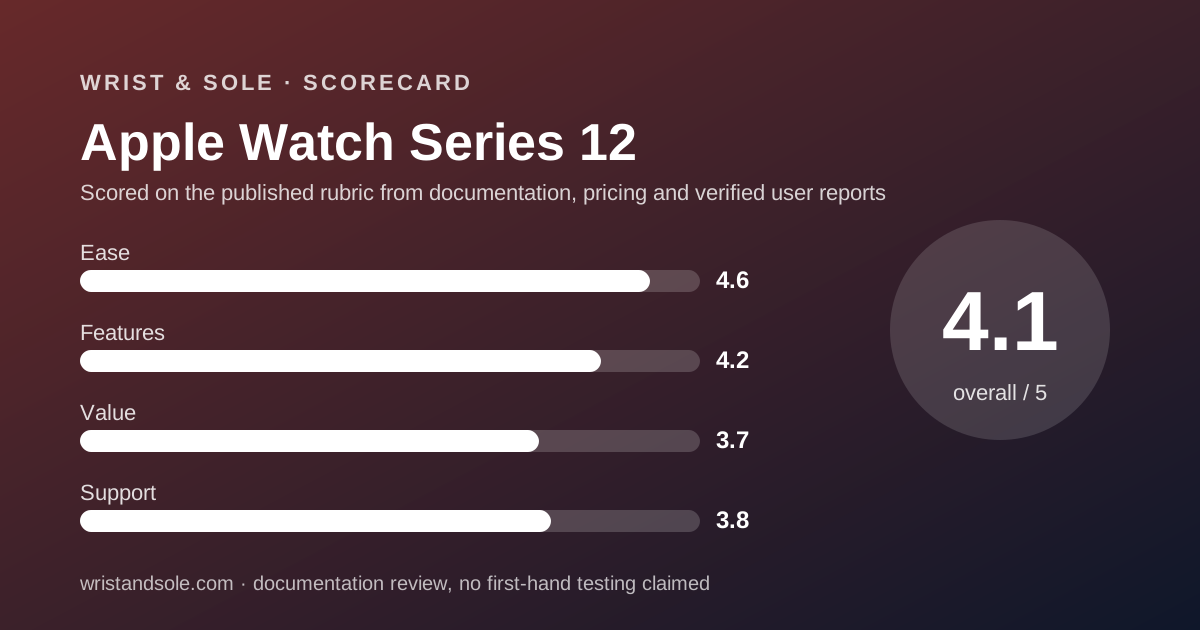
Scored on the published rubric, from documentation, pricing and verified user reports.
Best for: An iPhone owner who runs a few times a week and wants one watch for workouts, payments, messages and health alerts, and who is willing to charge it every night.
Verdict
The Apple Watch Series 12 is the easiest watch in our sports cluster to live with and the hardest to run far with. Apple's tech specs page, checked October 17, 2026, lists a 42 mm aluminum GPS model at 32.2 g and a 46 mm at 39.5 g, a 2,000-nit LTPO3 OLED, 50 m water resistance under ISO 22810:2010 plus IP6X dust resistance, Precision L1 GPS, and battery life of up to 24 hours, 38 hours in Low Power Mode and up to 10 hours of outdoor-run workout tracking. This is a documentation review built from Apple's specs page, store page, newsroom release and warranty text; we did not wear or run with the watch. The strengths are the sensor set, with ECG, blood oxygen, temperature and a depth gauge, the published 2,000-nit brightness and the fit ranges Apple states for each band. The limits are structural: it requires an iPhone 11 or later on iOS 27, its GPS is single-band L1 while the Garmin, Coros and Pixel watches in this cluster list multi-band, and 10 hours of GPS is half the Garmin Forerunner 265 figure and about a quarter of the Coros Pace 3 figure. Apple publishes no owner ratings on its store, so this review has no owner-report numbers.
Visit Apple Watch Series 12
We have no affiliate relationship with this vendor. Link goes to the official site.
Where it is strong
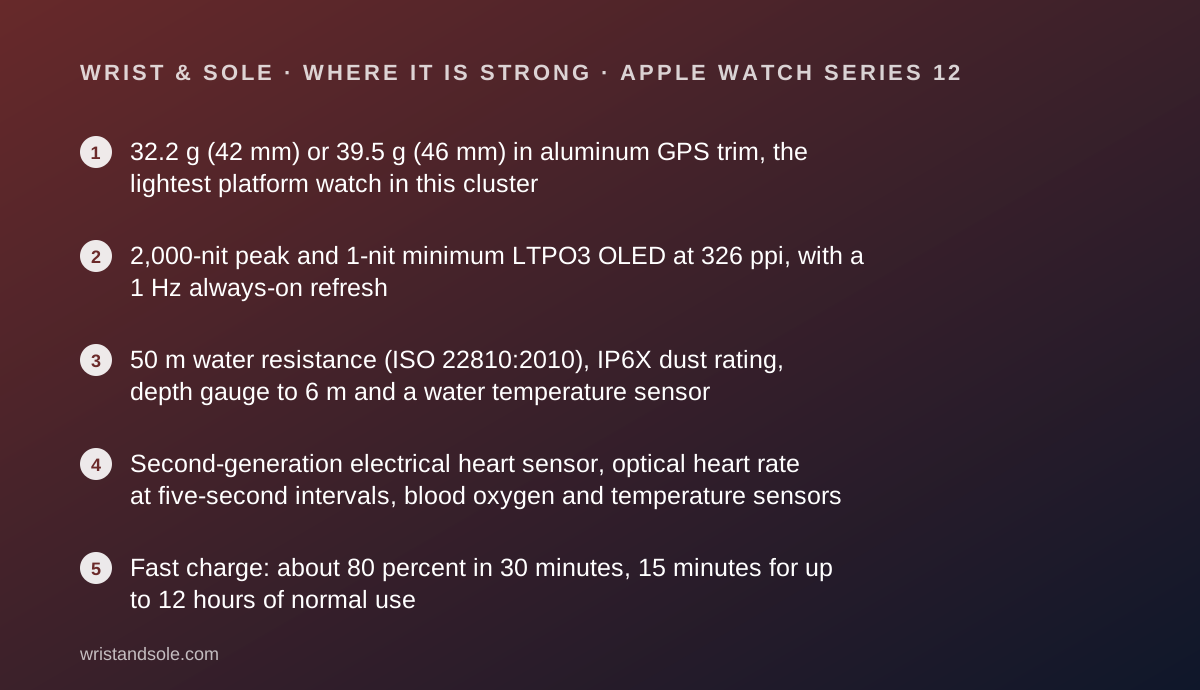
- 32.2 g (42 mm) or 39.5 g (46 mm) in aluminum GPS trim, the lightest platform watch in this cluster
- 2,000-nit peak and 1-nit minimum LTPO3 OLED at 326 ppi, with a 1 Hz always-on refresh
- 50 m water resistance (ISO 22810:2010), IP6X dust rating, depth gauge to 6 m and a water temperature sensor
- Second-generation electrical heart sensor, optical heart rate at five-second intervals, blood oxygen and temperature sensors
- Fast charge: about 80 percent in 30 minutes, 15 minutes for up to 12 hours of normal use
- Band fit ranges published per case: 130 to 200 mm (42 mm) and 140 to 245 mm (46 mm)
Where it falls short
- Up to 24 hours of normal use and up to 10 hours of outdoor-run GPS tracking; the Garmin lists 20 GPS hours, the Coros 38
- Precision L1 GPS only; the other three watches in this cluster list dual-frequency or multi-band reception
- Requires an iPhone 11 or later running iOS 27; no Android pairing
- Proprietary band connector, so no standard-width straps; Apple publishes no lug width
- Apple One-Year Limited Warranty, in line with Garmin and Google but half the Coros term
- No owner rating or review count on apple.com, so there is no first-party owner data to grade
At a glance
| Case size | 42 x 37 x 9.7 mm or 46 x 40 x 9.7 mm (aluminum and titanium); ceramic 43 x 37 x 9.85 mm or 47 x 41 x 9.85 mm |
|---|---|
| Weight | Aluminum GPS 32.2 g (42 mm) / 39.5 g (46 mm); titanium 36.5 g / 44.9 g; ceramic 41.7 to 52.9 g |
| Display | LTPO3 wide-angle OLED, 374 x 446 px (42 mm) or 416 x 496 px (46 mm), 326 ppi, 2,000 nits peak, 1 nit minimum |
| Crystal | Ceramic Shield 2 (aluminum); sapphire (titanium and ceramic) |
| Water and dust | 50 m, ISO 22810:2010; IP6X; depth gauge to 6 m |
| Battery (GPS workout) | Up to 10 h outdoor run with heart rate on, without iPhone (Apple figure) |
| Battery (all day) | Up to 24 h normal use; up to 38 h Low Power Mode |
| GPS | Precision L1 GPS: GPS, GLONASS, Galileo, QZSS, BeiDou |
| Sensors | Electrical heart sensor (ECG), optical heart sensor, blood oxygen, temperature, compass, always-on altimeter, high-g accelerometer, gyroscope, ambient light, water temperature |
| Band fit | 42 mm case fits 130 to 200 mm wrists; 46 mm fits 140 to 245 mm; proprietary connector |
| Chip and storage | S11 chip, 64 GB |
| Warranty | Apple One-Year Limited Warranty |
| List price | From $399 (42 mm GPS, aluminum), apple.com, October 17, 2026 |
| Pricing note | From $399 for the 42 mm aluminum GPS model, $449 for 46 mm, GPS + Cellular from $499, titanium from $699, ceramic from $899, per apple.com checked October 17, 2026 |
What the Apple Watch Series 12 actually is
The Series 12 is Apple's mainstream watch, announced September 9, 2026 and in stores from September 18, per Apple's newsroom. It is a general-purpose smartwatch that happens to have a strong workout app, which is the opposite of how the Garmin Forerunner 265 and Coros Pace 3 are built.
The case comes in two sizes and three materials. Apple's specs page lists 42 mm and 46 mm heights, 9.7 mm depth for aluminum and titanium, and 9.85 mm for ceramic. Aluminum GPS models weigh 32.2 g and 39.5 g; titanium 36.5 g and 44.9 g; ceramic between 41.7 g and 52.9 g.
The watch cannot be set up without an iPhone. Apple's compatibility line requires an iPhone 11 or later running iOS 27. That single row removes it from consideration for every Android runner, which is why our sports watch cluster also includes the Pixel Watch 5.
For the vocabulary below, our watch spec sheet primer explains case height versus diameter and what an ISO 22810 water rating does and does not promise. Apple's 42 mm figure is a height; the width is 37 mm.
Who the Apple Watch Series 12 is best for
On the published spec sheet, the Series 12 fits a particular runner well and a different runner badly.
- iPhone owners who run three to five times a week for under two hours and want workouts, payments and messages on one device
- Runners who care about health sensing between runs: ECG, blood oxygen, temperature, sleep apnea and irregular rhythm notifications are all listed
- People who want the brightest published screen; Apple states 2,000 nits peak, Google 3,000, and Garmin and Coros publish no figure
- Swimmers who want a depth gauge and water temperature sensor on a watch rated 50 m
- Anyone who charges a watch nightly already and does not need a multi-day battery
- Who should skip it: Android users, marathon and ultra runners who need more than 10 GPS hours, and anyone who wants a standard-width strap
How the pricing works
Apple prices by size, connectivity and material, and the store page spells all three out. Read October 17, 2026: 42 mm aluminum GPS from $399, 46 mm from $449. Adding cellular takes the start to $499. Titanium cases start at $699 and ceramic at $899, and both of those come with cellular included.
The band is part of the price but Apple's configurator prices some bands separately. A Sport Band is the default. The Milanese Loop and Modern Buckle are listed in Apple's footnotes as not water resistant, which matters for a watch rated to 50 m.
Nothing on the spec sheet is subscription-gated. Apple Fitness+ is a separate paid service for guided workouts; the Workout app, GPS, heart rate and the health notifications in the spec list work without it.
AppleCare+ with Theft and Loss was $4.99 a month or $49.99 a year on the store page. Apple Trade In offered $30 to $430 in credit toward a new watch, depending on the device returned.
Against mechanical watches at the same money, the comparison is different in kind. Our best everyday watches under $500 guide covers watches that will still run in 2036; the Series 12 will be out of software support well before then, which is a cost Apple does not print on the spec sheet.
Ease: fit ranges, screen and charging
The ease score is the highest in this cluster, built from three published facts: Apple states a wrist fit range per case size, the screen has a 1-nit floor and a 2,000-nit peak, and fast charging is specified in minutes.
Fit ranges are explicit. The 42 mm case fits 130 to 200 mm wrists and the 46 mm fits 140 to 245 mm, per Apple's specs page. Those overlap most of the 135 to 205 mm Garmin range and start lower than the 145 mm floor on the Casio G-Shock GA2100.
The display is an LTPO3 wide-angle OLED at 326 ppi: 374 x 446 pixels on the 42 mm and 416 x 496 on the 46 mm. Apple lists a 1 Hz always-on refresh and a 1-nit minimum for dark rooms. The 2,000-nit peak is a published number; we have not measured it.
Charging is the part a runner should read twice. Apple publishes about 80 percent in 30 minutes and 15 minutes for up to 12 hours of normal use. That is how a 24-hour watch is meant to work: short top-ups rather than overnight charging. A runner who forgets the charger for a weekend has no slack.
Controls are the Digital Crown, a side button and the touchscreen. Apple does not list a button-only workout mode; the Ultra line has an Action button, the Series 12 does not.
Features: what the spec sheet does and does not say
The sensor list is the longest in our cluster. Apple's specs name a second-generation electrical heart sensor for ECG, an always-on optical heart sensor, a blood oxygen sensor, a temperature sensor, compass, always-on altimeter, high-g accelerometer, high dynamic range gyroscope, ambient light sensor, a depth gauge to 6 meters and a water temperature sensor.
Apple's product page adds that the optical sensor now reads heart rate every five seconds all day and HRV as often as every five minutes. The newsroom release calls this the Health Sensing System and says training load feeds a new Readiness score. Apple's accuracy claim cites Apple's own study, not an independent one.
For running specifically, the sheet is thinner than Garmin's. GPS is Precision L1 covering GPS, GLONASS, Galileo, QZSS and BeiDou, with no L5 band. Apple publishes one GPS battery figure, up to 10 hours for an outdoor run, not a table by satellite mode. Workout Buddy, the on-watch coaching voice, needs Wi-Fi or cellular, per the newsroom page.
Storage is 64 GB, eight times the Garmin and sixteen times the Coros. The S11 chip runs a 4-core Neural Engine. Cellular is 5G on the GPS + Cellular models, which is a feature no dedicated running watch in this cluster offers.
What is missing: no multi-band GPS, no published breadcrumb or course navigation in the specs, no ANT+ for older chest straps and bike sensors, and no standard lug. The running shoe spec sheet primer makes the same point about shoes: what a brand leaves off the sheet is usually the number you need.
Value: cheapest to start, most expensive to replace
The value score is middling, and the reason is lifespan rather than list price.
At $399 the Series 12 is the cheapest entry in this cluster after the $199 Coros Pace 3, and $50.99 below the Garmin Forerunner 265. For an iPhone owner, that money buys a phone-class watch with a workout app, which is more device per dollar than any running watch.
The trade is battery and longevity. Apple's own numbers are 24 hours of normal use against Garmin's 13 days and Coros's 15 days. And Apple drops older watches from watchOS updates on a schedule it does not publish in advance; a Garmin or Coros watch keeps recording runs after its last firmware update, an Apple Watch loses features.
The 46 mm at $449 lands one dollar below the Garmin at $449.99 and $19.01 above the 45 mm Pixel Watch 5 at $429.99. At that size, the buyer is choosing between a 24-hour watch with the best health sensors, a 40-hour Android watch with dual-frequency GPS, and a 13-day running watch.
Bands are a recurring cost. Apple's connector is proprietary, so there is no $15 nylon strap option; third-party bands exist but Apple publishes no width specification for them. The Seiko 5 Sports on a standard 22 mm lug illustrates the opposite approach at a lower price.
Support: one year, AppleCare optional
Apple's One-Year Limited Warranty covers Apple-branded hardware for one year from the original retail purchase against defects in materials and workmanship, per the warranty text read October 17, 2026. That matches Garmin and Google and is half the Coros two-year term.
Battery is covered as a component, but normal capacity loss is treated as wear. Apple's battery service outside warranty is a paid repair. The Low Power Mode figure of 38 hours assumes a new battery.
AppleCare+ with Theft and Loss extends coverage for $4.99 a month or $49.99 a year, per the store page, with accidental damage covered under a service fee. Apple does not publish repair turnaround times on the product page.
Support channels are the Apple Store, Apple Support app, chat and phone. Software support is the open question: Apple commits to watchOS updates for a number of years it does not state at purchase, and the watch requires iOS 27 on the paired phone, so a phone that falls off iOS updates takes the watch with it.
What verified owners report
Apple's store does not display owner ratings or reviews on the Series 12 pages, so there is no first-party owner number to report, and we do not import retailer or search-snippet ratings on this site.
What Apple does publish is its own test basis. The battery figures come from preproduction units running prerelease software, per the newsroom footnotes, and Apple says actual results vary with configuration and use. The heart rate accuracy claim cites an Apple study rather than an independent one.
The water resistance footnote is specific: the rating is not permanent and may diminish over time, and Apple lists which bands are not water resistant. Those are useful rows because they tell a swimmer which configurations to avoid.
When a retailer with verified-purchase labelling shows a readable rating for this model, we will add it here with a date. The same gap exists in our Hoka Clifton review, where the brand page carried no owner rating.
Alternatives
Three watches in this cluster overlap with the Series 12, and the choice depends mostly on which phone you own and how long you run.
Google Pixel Watch 5. Choose it if you use Android: 45 mm at $429.99 with dual-frequency GPS, a 3,000-nit screen and up to 40 hours of battery, read October 17, 2026. Otherwise choose the Apple Watch, because it will not pair with an iPhone and the Series 12 will not pair with Android.
Garmin Forerunner 265. Choose it if you train for races and want 20 hours of GPS, 13 days of battery and a standard 22 mm strap at $449.99. Otherwise choose the Series 12 for ECG, blood oxygen, 64 GB, payments and messages.
Coros Pace 3. Choose it if you want the longest GPS battery for the least money: 38 hours standard GPS, 30 g on a nylon band, $199.00 and a two-year warranty. Otherwise choose the Series 12 if you want a color touchscreen and a phone-class app list.
For a watch that does nothing but tell time and survive a swim, the Citizen Promaster diver at 200 m and no charging is the other end of the spectrum.
Bottom line
The Apple Watch Series 12 is the best general-purpose watch in our sports cluster and the weakest dedicated running watch in it, and both conclusions come from Apple's own spec sheet.
For an iPhone owner running under two hours at a time, it is hard to argue against: $399, 32.2 g, 2,000 nits, 50 m, the longest sensor list and nightly charging that takes 30 minutes. For a marathoner, 10 hours of GPS and single-band L1 reception are real limits that Garmin and Coros do not have.
If you are choosing your first watch as a new runner, read it alongside the shoes. Our daily trainers for new runners guide covers the purchase that will matter more to your first 5K than any watch will.
Buy it if
- You own an iPhone 11 or later and want one watch for running, payments, messages and health notifications
- Your runs are under three hours and you can charge the watch nightly or during a shower
- You want ECG, blood oxygen and temperature sensing on the same device that records your run
- Screen brightness matters: Apple publishes 2,000 nits peak, which Garmin and Coros do not publish at all
Skip it if
- You use an Android phone; the watch will not pair with it
- You run marathons or ultras and need more than 10 hours of GPS tracking on one charge
- You want a standard-width strap or a warranty longer than one year
Frequently asked
How much does the Apple Watch Series 12 cost?
Apple's US store listed the 42 mm aluminum GPS model from $399 and the 46 mm from $449 on October 17, 2026. GPS + Cellular starts at $499, titanium cases start at $699 and ceramic at $899; titanium and ceramic include cellular. Apple announced the watch on September 9, 2026.
How long does the Apple Watch Series 12 battery last on a run?
Apple publishes up to 10 hours of workout tracking for an outdoor run with the heart rate sensor on and no iPhone present, as of October 2026. All-day use is rated at up to 24 hours, or 38 hours in Low Power Mode. Apple notes the figures come from preproduction units.
Does the Apple Watch Series 12 have dual-frequency GPS?
No. Apple's tech specs list Precision L1 GPS covering GPS, GLONASS, Galileo, QZSS and BeiDou. Dual-frequency L1 plus L5 reception is reserved for the Ultra line. The Garmin Forerunner 265, Coros Pace 3 and Pixel Watch 5 all list multi-band or dual-frequency modes.
Is the Apple Watch Series 12 waterproof for swimming?
Apple rates it water resistant to 50 meters under ISO 22810:2010, which Apple describes as suitable for shallow-water activities such as swimming in a pool or ocean, and dust resistant to IP6X. Apple says it should not be used for scuba diving or high-velocity water sports.
How much does the Apple Watch Series 12 weigh?
Per Apple's specs, the 42 mm aluminum GPS case is 32.2 g and the 46 mm is 39.5 g, case only. Titanium is 36.5 g and 44.9 g, ceramic 41.7 to 52.9 g. The band adds weight that Apple does not publish per band.
Will the Apple Watch Series 12 work with an Android phone?
No. Apple's compatibility line requires an iPhone 11 or later, including iPhone SE second generation or later, running iOS 27 or later. There is no Android companion app. Android users should look at the Pixel Watch 5 or a Garmin or Coros watch, which pair with either platform.
What warranty does Apple give on the Apple Watch?
Apple's One-Year Limited Warranty covers Apple-branded hardware against defects in materials and workmanship for one year from the original retail purchase. Batteries are covered as hardware but normal capacity loss is not a defect. AppleCare+ was offered at $4.99 a month or $49.99 a year on October 17, 2026.
Sources
- Apple Watch Series 12 tech specs (dimensions, weights, display, sensors, battery, band fit) - checked October 17, 2026
- Apple Watch Series 12 product page (Health Sensing System, water and dust ratings) - checked October 17, 2026
- Apple Store, Buy Apple Watch Series 12 (prices by size, connectivity and material) - checked October 17, 2026
- Apple Newsroom, Introducing Apple Watch Series 12 (announcement date, availability, workout battery) - checked October 17, 2026
- Apple One (1) Year Limited Warranty - checked October 17, 2026
Update history
- October 17, 2026 - First documentation review from Apple tech specs, store, newsroom and warranty pages. Slug kept generation-free so the page is updated in place each September.
Visit Apple Watch Series 12
We have no affiliate relationship with this vendor. Link goes to the official site.