 Wrist
Saucony Peregrine 16 vs Merrell Agility Peak 6
Both of these trail shoes publish a stack height, a lug depth and a Vibram Megagrip outsole. We pick the Saucony Peregrine 16 at $150.00 for mixed trail and the Merrell Agility Peak 6 at $160.00 for rough ground.
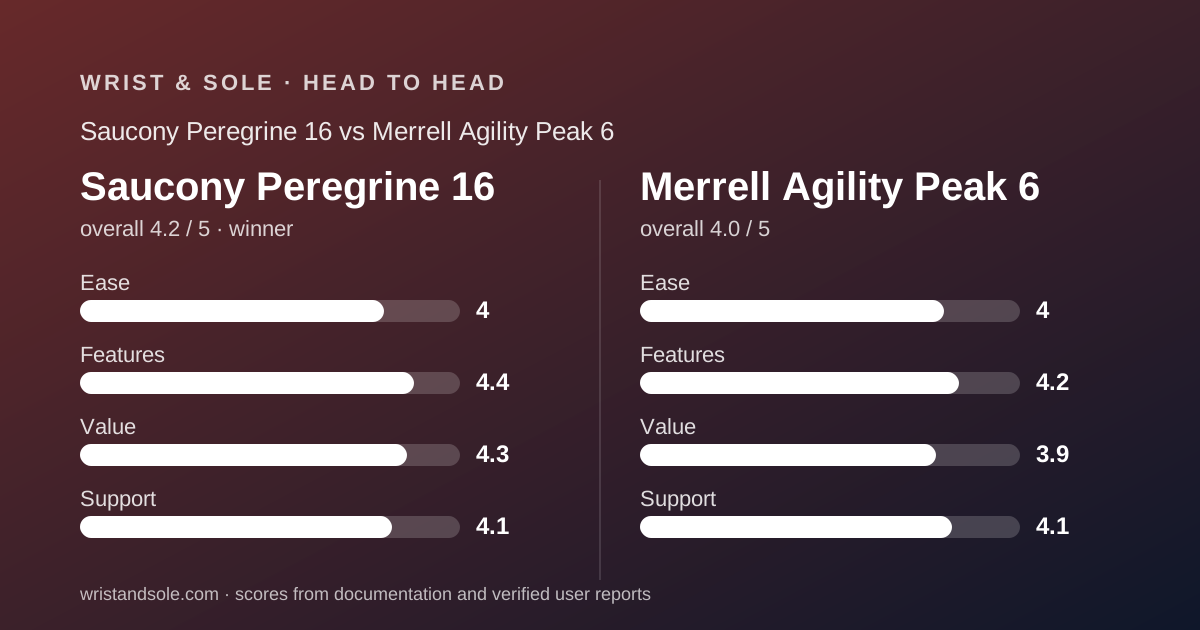
 4.2Saucony Peregrine 16
 4.0Merrell Agility Peak 6
Specification by specification
| Spec | Saucony Peregrine 16 | Merrell Agility Peak 6 |
|---|---|---|
| List price (Oct 30, 2026) | $150.00 men's and women's | $160.00 men's and women's |
| Waterproof version | Peregrine 16 GTX, $180.00 | Agility Peak 6 GORE-TEX, $185.00 |
| Stack height | 32 mm heel / 28 mm forefoot | 38 mm heel / 30 mm forefoot in the panel; 38 mm in the bullets |
| Heel-to-toe drop | 4 mm (Saucony calls it offset) | 8 mm |
| Lug depth | 4 mm | 5 mm |
| Outsole | Full-coverage Vibram Megagrip | Vibram Megagrip with Vibram traction lugs at 100% lug coverage |
| Midsole | PWRRUN foam | FloatPro foam with FLEXconnect grooves |
| Rock plate stated | Not stated on the page we read | Yes, a flexible impact-resistant underfoot shield |
| Published weight, men's | 9.5 oz / 271 g | 10.12 oz / 287 g in the panel; 10.05 oz / 285 g in the bullets |
| Published weight, women's | 8.4 oz / 239 g | 8.08 oz / 229 g |
| Reference size for weight | Not stated | Not stated |
| Upper | High strength mesh, added toe protection, gaiter compatible | Breathable mesh, synthetic and TPU, bellows tongue, 3D print overlays |
| Sizes, men's | US 7 to 13 in half sizes, then 14 and 15 | US 7 to 12 in half sizes, then 13, 14 and 15 (no 12.5) |
| Widths | Medium in this style; Wide is a separate style at $150.00 | Medium in this style; a Wide Width style is listed separately |
| Colours listed | 7 men's | 9 men's |
| Brand rating on its own page | 4.3 / 5 from 85 men's; 4.4 / 5 from 53 women's | 4.1 / 5 from 83 men's; 4.0 / 5 from 89 women's |
| Written owner reviews readable | No, widget did not render | No, widget did not render |
| Return window | 30 days, unworn only, free return shipping | 30 days, unworn only, free returns and exchanges |
| Defect warranty stated | One year, United States only | One year, United States only |
The short answer
Read from the brand pages on October 30, 2026, the Peregrine 16 is $150.00, a 4 mm offset over a 32/28 mm stack, 4 mm lugs and a published 9.5 oz.
The Agility Peak 6 is $160.00, an 8 mm drop over a 38/30 mm stack, 5 mm lugs and a published 10.12 oz, with a stated rock plate.
This is a documentation comparison. Neither shoe was worn or run by us, and every figure here is the brand's own, read on one date.
Two sentences decide most buyers, and the terrain decides which sentence applies.
- The Saucony Peregrine 16 is best for mixed trail, lower weight and a smaller drop change from a road shoe, at $150.00 - read our full Saucony Peregrine 16 review
- The Merrell Agility Peak 6 is best for rough, rocky, debris-heavy ground where 38 mm of stack, 5 mm lugs and a rock plate earn their keep, at $160.00 - read our full Merrell Agility Peak 6 review
- Winner on our rubric: Saucony Peregrine 16, on price, published weight and spec-sheet consistency, not on ride, which we did not evaluate
Both brands belong to the same parent, which is why the pages look alike
Saucony and Merrell are both Wolverine World Wide brands, and the two product pages run on the same commerce platform.
That has a practical consequence. The spec panels use the same layout, the returns language is nearly identical, and both limited warranty pages are signed by Wolverine World Wide rather than by the brand.
So the comparison is unusually clean. Two shoes, one retail system, one warranty author, one date of reading.
It also means a shared weakness. Neither review widget rendered its written reviews when we loaded the pages on October 30, 2026, so both shoes are compared on aggregates and specifications only.
For why that matters, our primer on reading a running shoe spec sheet sets out which rows are checkable and which are copy.
Price: the Peregrine 16 is $10 cheaper, and both charge more for waterproofing
The Peregrine 16 lists at $150.00 and the Agility Peak 6 at $160.00 on October 30, 2026, in both men's and women's.
Neither shoe was discounted on the brand's own store. Neither showed a strike-through price or a promotional badge on the pages we read.
The waterproof versions cost $180.00 and $185.00 respectively. By our arithmetic that is a $30.00 surcharge at Saucony and a $25.00 surcharge at Merrell.
Both brands offer free shipping above $75.00, which one pair of shoes clears. Merrell adds free express shipping above $125.00, which one pair does not.
The $10.00 gap is not the deciding factor. What the extra $10.00 buys at Merrell is 6 mm more heel stack, 1 mm more lug and a rock plate, and what it costs is about half an ounce.
Geometry: the Agility Peak 6 is taller and steeper, the Peregrine 16 is flatter and lower
This is the real difference between the two shoes and it is fully documented on both sides.
Saucony publishes a 4 mm offset with the stack behind it: 32 mm at the heel, 28 mm at the forefoot. Merrell publishes an 8 mm drop over 38 mm at the heel and 30 mm at the forefoot.
So the Merrell is 6 mm taller at the heel, 2 mm taller at the forefoot and twice the drop. Those are brand figures read on the same day, not measurements of our own.
What that means in practice is a choice rather than a ranking. A 4 mm offset asks more of the calf and achilles and gives more ground feel; an 8 mm offset is closer to what most road trainers use.
If you are moving from a conventional road shoe, the Merrell is the smaller change. The Hoka Clifton 11 publishes the same 8 mm drop and the Brooks Ghost 18 publishes 10 mm.
If you already run in something low, the Peregrine 16 is the closer match. The New Balance 1080v15 at a published 6 mm is the nearest road equivalent we have read.
One caveat on the Merrell numbers. The spec panel says 38-30 mm and the bullet list on the same page says 38 mm with no forefoot figure. We print both and treat the panel as the fuller statement.
Grip: Merrell publishes the deeper lug, Saucony publishes the simpler claim
Both shoes use Vibram Megagrip, which is the same supplier compound family rather than two in-house rubbers.
The lug depths differ by 1 mm. Saucony publishes 4 mm and Merrell publishes 5 mm.
Saucony describes its outsole as full coverage, meaning rubber across the whole sole rather than exposed foam. Merrell says it expanded Vibram traction lug coverage to 100 percent of the outsole lugs for this version, and that its lugs are designed to shed debris.
Those two claims are not the same claim and the pages do not let us reconcile them. Full coverage is about how much of the sole is rubber; 100 percent lug coverage is about how many lugs are the Vibram compound.
On published numbers the Merrell has the deeper bite. On wet rock, Megagrip is the common factor and neither page gives a coefficient we could compare.
Neither brand publishes a rubber hardness, so a 1 mm lug difference is the only hard grip number in this comparison.
Protection: only Merrell states a rock plate
Merrell lists a lightweight, impact-resistant underfoot shield that it says gives flexible defence against sharp, uneven terrain. That is a rock plate described by function.
The Saucony page we read states added toe protection and gaiter compatibility, but no plate between foot and ground.
We treat that as an absence on the page rather than as a denial by Saucony. If a rock plate is the thing you are shopping for, the Merrell page states one and the Saucony page does not.
The Saucony page states something Merrell's does not: gaiter compatibility. Merrell's answer to debris is a bellows tongue rather than a gaiter attachment.
So the protection trade is plate against gaiter. Sharp rock favours Merrell; sand, scree and snow at the ankle favour Saucony.
Weight: the Peregrine 16 is lighter in men's and heavier in women's
This row is less tidy than it looks and worth reading twice.
In men's, Saucony publishes 9.5 oz (271 g) and Merrell publishes 10.12 oz (287 g) in its panel. The Saucony is lighter by about 16 g.
In women's, the direction reverses. Saucony publishes 8.4 oz (239 g) and Merrell publishes 8.08 oz (229 g). The Merrell is lighter by about 10 g.
Neither brand states the size it weighed, so neither pair of figures is strictly comparable. A women's sample is usually a smaller size than a men's sample, which is why cross-gender comparison does not work here either.
Merrell also contradicts itself. Its bullet list gives a half pair weight of 10.05 oz (285 g) against the panel's 10.12 oz (287 g). The gap is 2 g and that is exactly why it is worth flagging.
If weight is the deciding factor, men's buyers should favour the Peregrine 16 and women's buyers should favour the Agility Peak 6, on the brands' own published numbers.
Sizing and widths: Saucony covers more half sizes, Merrell skips 12.5
Both brands list Medium only in the style we read, and both sell a wide fitting as a separate style number.
Saucony's men's run is US 7 to 13 in half sizes, then 14 and 15. The Peregrine 16 Wide is a separate page at the same $150.00.
Merrell's men's run is US 7 to 12 in half sizes, then 13, 14 and 15. There is no 12.5. A Wide Width style is listed from the page's type selector.
That missing half size is a genuine exclusion rather than a stock issue, and it rules the Agility Peak 6 out for anyone who takes a 12.5.
Neither page handles width as well as a page that lists both fittings in one size grid. Our note on width letters and returns explains why brands separate them, and the Brooks Adrenaline GTS 25 shows what four widths on one page looks like.
Saucony's page also carries its own sizing advice, recommending a size up from your usual lifestyle shoe size for performance models.
Returns and warranty: identical terms, written by the same parent company
There is no advantage on either side here, which is itself worth knowing.
Both pages state a 30-day return window for unworn merchandise, with free return shipping and free exchanges. Neither allows a shoe to be run on a trail and then sent back.
Merrell's site carried a banner offering extended returns through January 31, 2027 when we read it. That extends the window, not the unworn condition.
Both limited warranty pages are issued by Wolverine World Wide and both state one year from the verified date of purchase against defects in materials and workmanship, in the United States only.
Both exclude misuse, negligence, normal wear and tear, accident, improper care and modification. Both require proof of purchase and both quote six to eight weeks to process a claim.
Merrell adds an explicit clause rejecting claims on shoes bought from unauthorised sellers, including unauthorised internet sites. Saucony's page limits the warranty to the United States without naming marketplaces.
Normal wear and tear is the clause that decides most trail claims, and our note on when to replace running shoes explains where that line usually falls.
What owners report: aggregates only, and Saucony is ahead on both
Saucony showed 4.3 out of 5 from 85 men's ratings and 4.4 from 53 women's ratings on October 30, 2026.
Merrell showed 4.1 out of 5 from 83 men's ratings and 4.0 from 89 women's ratings on the same day.
Those are the figures the brands display and we did not recalculate them. The samples are close in size, which makes the comparison fairer than most.
What neither page gave us is a written review or a fit breakdown. Both review widgets failed to render their review text, so there is no owner comment to quote on either side and no sizing vote to report.
We will not substitute ratings from retailers. On the brands' own pages, Saucony is 0.2 points ahead in men's and 0.4 points ahead in women's, and that is the whole of the owner evidence available.
Also compared: two $145 shoes that answer the question differently
Two other trail shoes sat on our desk on the same date and neither made this comparison, for reasons worth stating.
The Altra Lone Peak 9 lists at $145.00 with a 0 mm drop and a 25 mm stack. It is a different design argument rather than a cheaper version of these two, and it publishes no lug depth at all.
It does allow a worn return inside 30 days, which neither shoe here does. For a buyer who cannot try shoes on, that policy is worth more than a millimetre of lug.
The Topo Terraventure 5 also lists at $145.00, with a 3 mm drop, a 25/22 mm stack, a named ESS rock plate and every size in Standard and Wide on one page.
It was left out for owner data rather than specifications. Topo's own page showed 3.8 out of 5 from 38 ratings against 4.3 and 4.1 for the two shoes compared here.
It is also the only one of the four that states the size it weighed its shoes at, which makes its 10.3 oz figure more useful than the unreferenced weights on both pages above.
Choose the Peregrine 16 if, choose the Agility Peak 6 if
The decision comes down to terrain, geometry and whether a 12.5 is your size.
- Choose the Saucony Peregrine 16 if you want the lighter men's shoe, at a published 9.5 oz against about 10.1 oz
- Choose the Saucony Peregrine 16 if you want a lower 4 mm offset, gaiter compatibility, or simply the $10.00 saving
- Choose the Saucony Peregrine 16 if you take a men's 12.5, which Merrell does not list
- Choose the Merrell Agility Peak 6 if the ground is rocky and you want a stated rock plate and 5 mm lugs
- Choose the Merrell Agility Peak 6 if you want the taller platform, 38 mm at the heel against 32 mm
- Choose the Merrell Agility Peak 6 if you are coming from a 8 mm or 10 mm road trainer and do not want to change drop at the same time
- Choose the Merrell Agility Peak 6 if you are buying women's and weight is the deciding factor, at a published 8.08 oz against 8.4 oz
Bottom line
On documentation these are the two best pages in trail running, and they disagree about what a trail shoe should be.
The Peregrine 16 is the lower, lighter, cheaper shoe with the cleaner spec panel. The Agility Peak 6 is the taller, grippier, better protected shoe with a page that gives two answers on weight and stack.
Our rubric picks the Peregrine 16, because price, published weight and internal consistency are things a reader can check and ride is not.
If your trails are rough enough that Merrell's own Rugged rating applies, buy the Agility Peak 6 and ignore our pick.
If you are still choosing between road and trail in the first place, our daily trainers guide covers the four road shoes we have read on the same terms.
Frequently asked
Which is cheaper, the Peregrine 16 or the Agility Peak 6?
The Saucony Peregrine 16 at $150.00, against $160.00 for the Merrell Agility Peak 6, on the brands' own stores on October 30, 2026. The waterproof versions are $180.00 and $185.00. Neither shoe was discounted when we read the pages.
Which has more cushioning?
The Merrell Agility Peak 6, on published numbers. Merrell lists 38 mm at the heel and 30 mm at the forefoot, against 32 mm and 28 mm for the Peregrine 16. That is 6 mm more under the heel, by our arithmetic from the two spec panels.
Which has better grip on wet rock?
Neither page lets us answer that properly. Both use Vibram Megagrip, so the compound family is the same. Merrell publishes deeper lugs at 5 mm against 4 mm, but neither brand publishes a rubber hardness or a friction figure.
Does either shoe have a rock plate?
Merrell states one: a lightweight, impact-resistant underfoot shield giving flexible defence against sharp terrain. The Saucony page we read states added toe protection and gaiter compatibility but no plate. That is an absence on the page, not a statement by Saucony.
Can I run in either shoe and still return it?
No. Both brands accept returns of unworn merchandise within 30 days, with free return shipping. Both limited warranties, written by Wolverine World Wide, run one year against defects and exclude normal wear and tear.
Which should a first-time trail buyer pick?
The Peregrine 16 for mixed trail, on price, weight and a consistent spec panel. The Agility Peak 6 if the ground is rough and an 8 mm drop matches the road shoe you already run in. Our guide to a first trail shoe ranks both against cheaper alternatives.
Visit Saucony Peregrine 16
We have no affiliate relationship with this vendor. Link goes to the official site.
Visit Merrell Agility Peak 6
We have no affiliate relationship with this vendor. Link goes to the official site.