 Wrist
Garmin Forerunner 265 vs Coros Pace 3: which to buy
The Coros Pace 3 is the better buy for most runners on the spec sheets: 38 hours of standard GPS against 20, a two-year warranty against one, and $199 against $449.99, all read October 17, 2026. The Garmin Forerunner 265 earns its extra $250.99 only if you want its 416 x 416 AMOLED screen, 8 GB of storage, ANT+, Wi-Fi and Garmin Pay. This is a documentation comparison built from each maker's product page, spec sheet and warranty text; we did not run with either watch. Read the full Garmin Forerunner 265 review and Coros Pace 3 review for every row.
 4.0Garmin Forerunner 265
 4.3Coros Pace 3
Specification by specification
| Spec | Garmin Forerunner 265 | Coros Pace 3 |
|---|---|---|
| List price (Oct 17, 2026) | $449.99 (46 mm; 42 mm 265S on the same page) | $199.00 (was $229.00) |
| Case size | 46.1 x 46.1 x 12.9 mm | 41.9 x 41.9 x 11.7 mm (excl. sensor) |
| Weight | 47 g | 30 g nylon band / 39 g silicone band |
| Display | 1.3 in AMOLED, 416 x 416, optional always-on | 1.2 in memory LCD, 240 x 240, 64 colors, always-on |
| Lens | Corning Gorilla Glass 3 | Mineral glass |
| Water rating | 5 ATM | 5 ATM, surface water only |
| Standard GPS battery | 20 h GPS-only | 38 h GPS/QZSS |
| Multi-band / dual-frequency battery | 14 h all-systems plus multi-band | 15 h dual-frequency |
| Smartwatch / daily battery | Up to 13 days | Up to 15 days |
| Satellite systems | GPS, GLONASS, Galileo, QZSS, BeiDou; SatIQ | GPS, GLONASS, Galileo, BeiDou, QZSS |
| Sensor pairing | Bluetooth and ANT+; Wi-Fi | Bluetooth; Wi-Fi for sync |
| Storage | 8 GB | 4 GB; 1,200 h activity memory |
| Payments | Garmin Pay | Not listed |
| Strap width | 22 mm quick release | 22 mm quick release |
| Warranty | 1 year from purchase, batteries excluded unless defective | 2 years from activation; bands 180 days |
The short answer
Two watches, one shared strap width, very different price tags.
- Coros Pace 3 is best for runners who want the most GPS hours, the longest warranty and the lowest price: 38 hours, two years, $199.
- Garmin Forerunner 265 is best for runners who want a sharp color screen, payments, music storage and ANT+ sensor support, and will pay $449.99 for them.
- Our pick for most buyers, and for every new runner, is the Coros Pace 3. Graded on documentation, spec sheets and warranty text; no tests of our own were run.
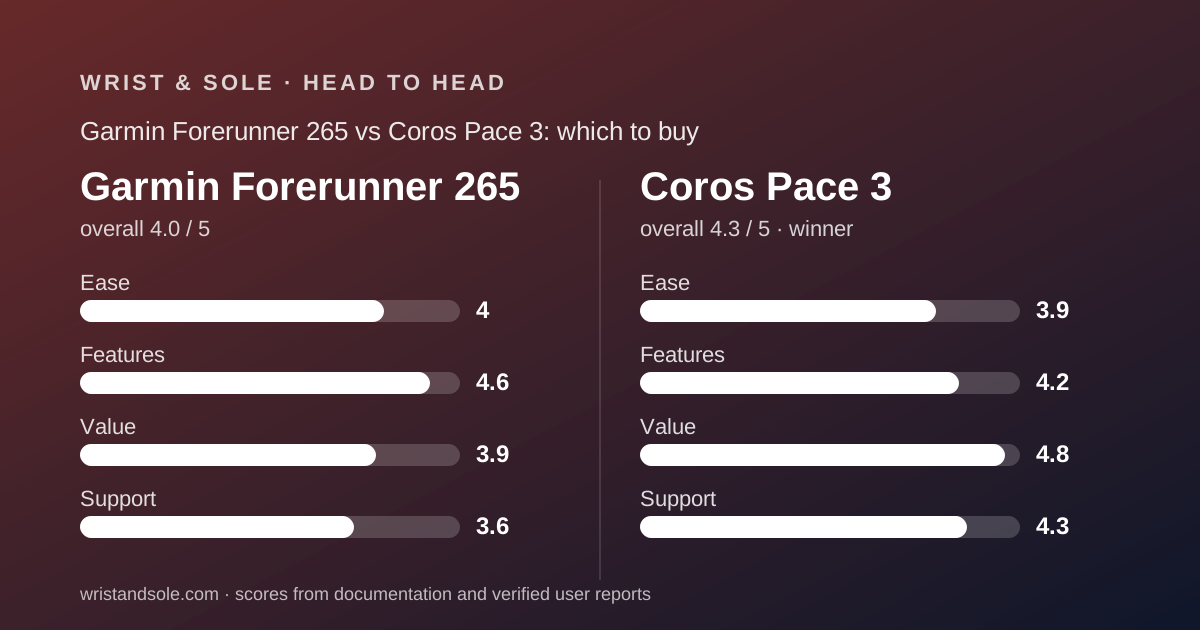
Price: the Coros costs $250.99 less, and that gap has widened
On October 17, 2026, Garmin's US store listed the 46 mm Forerunner 265 at $449.99, its 2023 launch price. Coros listed the Pace 3 at $199.00, with the original $229.00 struck through.
The gap is $250.99. Neither watch has a subscription for the features on its spec sheet. Garmin offers Affirm financing; Coros offers a 30-day money-back guarantee on orders from coros.com.
Accessories narrow the gap only a little. Coros bands were $29 and Garmin's own 22 mm bands $39.99. Both use a standard 22 mm quick-release width, so third-party straps work on either.
Editorial arithmetic: the Pace 3 plus the Coros POD 2 at $99 is $298, still $151.99 below the Garmin alone. For a sense of what $450 buys in a non-smart watch, our best everyday watches under $500 guide covers four spec sheets.
Battery: the Coros publishes nearly double the standard GPS hours
Battery is where the spec sheets differ most, and the Coros wins every comparable row.
In standard GPS, Coros lists 38 hours to Garmin's 20. In daily use, Coros lists 15 days to Garmin's 13 days in smartwatch mode. In the most accurate reception mode, the two are close: Coros lists 15 hours dual-frequency and Garmin 14 hours all-systems plus multi-band.
Music changes the picture. Coros lists 10, 9 and 7 hours with offline music across its three modes; Garmin lists 7, 6.5 and 6 hours with music. Both drop sharply.
For a marathon at four to five hours, both have margin. For a 50 km trail race or a full day in the hills, the Coros has more headroom in standard GPS.
Both makers note their figures depend on settings. Garmin adds that engineering changes may not be reflected in its specifications, and Coros that lithium-ion cells degrade over time.
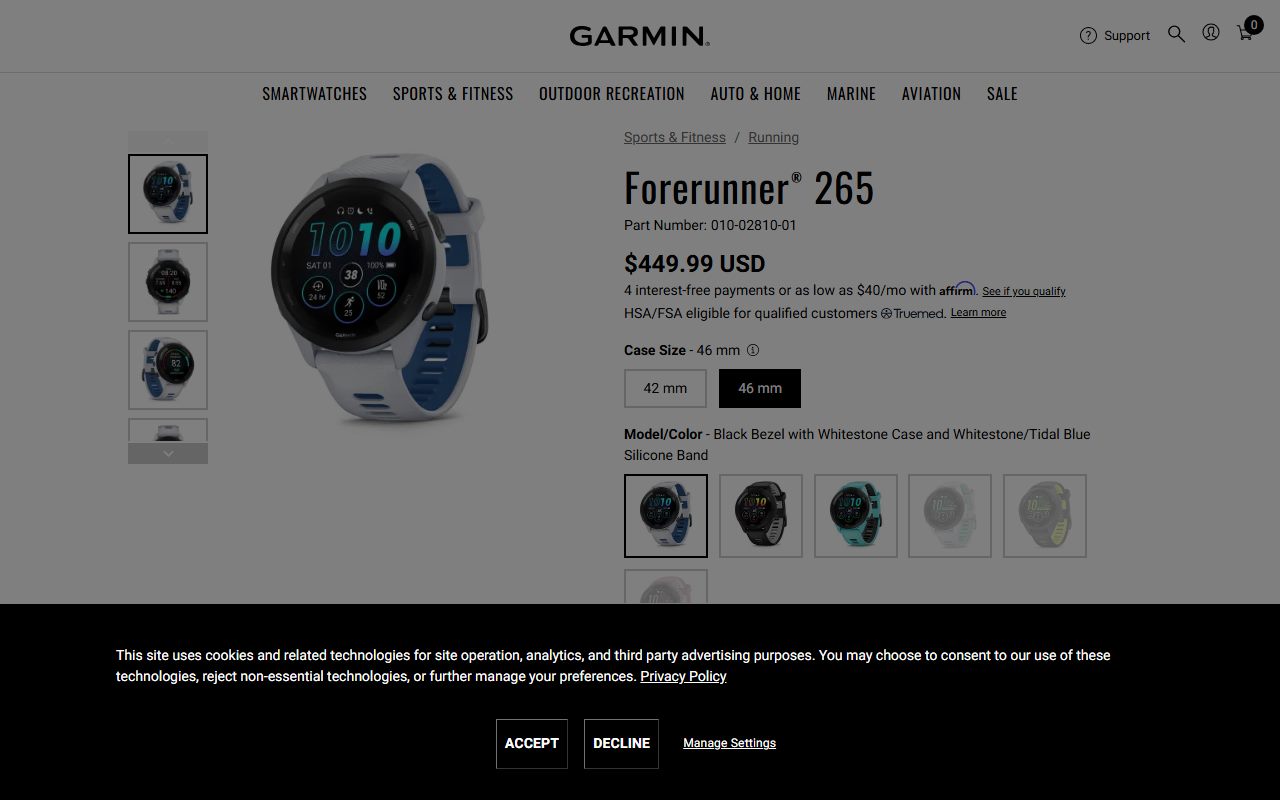
Screen: the Garmin's AMOLED is the main thing the extra money buys
The screen is the largest hardware difference and the main argument for the Garmin.
Garmin lists a 1.3-inch AMOLED at 416 x 416 pixels with optional always-on mode, behind Corning Gorilla Glass 3. Coros lists a 1.2-inch always-on memory LCD at 240 x 240 pixels and 64 colors, behind mineral glass.
On paper, the Garmin shows about three times the pixels: 173,056 against 57,600, by our arithmetic. Neither maker publishes a brightness figure in nits, unlike Apple and Google.
The trade-off is battery. The Coros screen is always on by design and still posts 38 GPS hours. Garmin lists always-on as optional on its AMOLED.
Both are touchscreens with physical controls: five buttons on the Garmin, a digital dial and back button on the Coros. For what these display rows mean, see our watch spec sheet primer.
Weight and size: the Coros is smaller and 17 g lighter
The Coros is the smaller and lighter watch on every published dimension.
The Garmin 46 mm case is 46.1 x 46.1 x 12.9 mm and 47 g. The Coros is 41.9 x 41.9 x 11.7 mm, with height excluding the optical sensor, and 30 g on the nylon band or 39 g on silicone.
Garmin sells a smaller 42 mm Forerunner 265S on the same product page. Coros sells one case size.
Fit ranges overlap. Garmin publishes 135 to 205 mm for the 46 mm strap. Coros publishes 135 to 205 mm on the standard nylon band, 150 to 235 mm on the long nylon band and 130 to 215 mm on silicone.
We do not judge comfort; neither watch was worn for this comparison. The published grams and millimeters are the facts a buyer can compare.
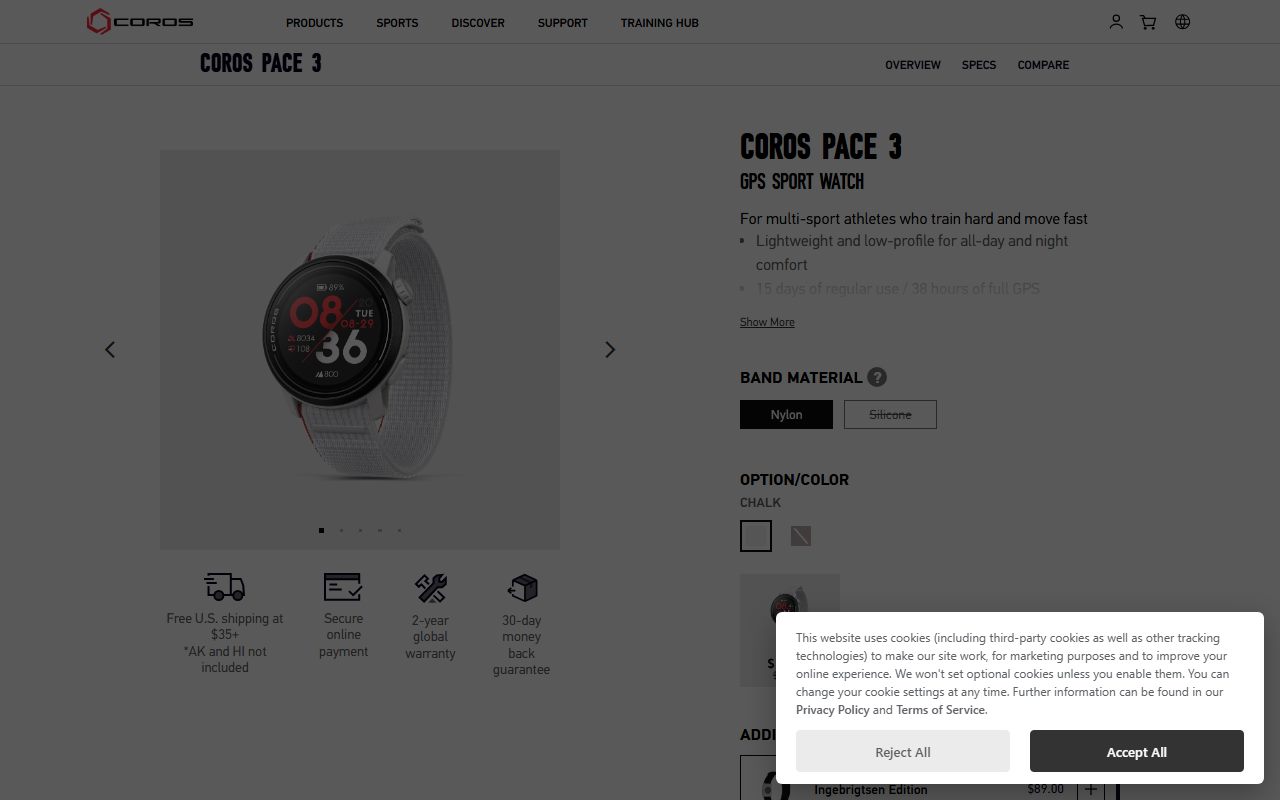
Features: the Garmin does more, the Coros covers what training needs
The Garmin has the longer feature list; the Coros covers the training core at less than half the price.
Both list the full five-system satellite set and a multi-band or dual-frequency mode. Garmin adds SatIQ, which picks a mode automatically, rated at 16 hours.
Garmin's extras are platform features: Garmin Pay, Wi-Fi, ANT+ and Bluetooth sensor pairing, 8 GB for music, Connect IQ apps, and Google Maps turn prompts with an Android phone. Coros pairs accessories over Bluetooth only, syncs over Wi-Fi, stores 4 GB, and lists no payments.
Training metrics are close in scope. Garmin lists training readiness, training status, PacePro, Body Battery and HRV sleep scoring. Coros lists EvoLab recovery, fatigue, training load, race predictor, VO2 max and threshold zones, plus Effort Pace and a virtual pacer.
Navigation: Coros lists breadcrumb routes with back-to-start and deviation alerts; Garmin's spec sheet lists no map layer either.
Sensors: both list optical heart rate, pulse oximetry, barometric altimeter, compass, gyroscope, accelerometer and thermometer.
Warranty: Coros gives two years, Garmin one with the battery excluded
Warranty is a clear Coros win.
Coros's limited warranty covers watches for two years from the original activation date. Bands carry 180 days. A replacement needed within 30 days of delivery is a new unit, subject to availability; later replacements are recertified.
Garmin's consumer limited warranty covers one year from purchase. It excludes cosmetic damage and consumable parts such as batteries unless a defect caused the failure. Repaired or replaced units carry 90 days or the rest of the original year.
For watches sold on battery claims, the battery wording matters. Coros's text does not single out batteries as excluded; Garmin's does.
Both exclude accidents, misuse and liquid-related corrosion or damage outside normal use. Both require claims through the maker's support process.
What owners report: no readable data on either side
Neither maker's page gave us verified owner numbers on October 17, 2026.
Garmin's product page carries a rating module that did not render in a full-browser load. The Coros store page showed no rating or review count. We do not take ratings from search snippets or unverified forums.
Both watches have been on sale long enough to have firmware histories. Garmin publishes software updates on its support site; Coros publishes a Latest Software Updates page. Both makers now sell newer models above these: the Forerunner 570 at Garmin, the Pace 4 and Pace 4 Pro at Coros.
This section will be updated when verified owner data is readable. The same gap applied to the shoes in our Brooks Ghost vs Hoka Clifton comparison on the Hoka side.
Charging: both use proprietary cables, the Coros states a charge time
Neither watch charges from a bare USB-C cable, and only Coros publishes how long a full charge takes.
Garmin lists its own plug-style charging cable for the Forerunner 265, not a USB-C port on the watch. Garmin does not publish a full-charge time on the product page we read.
Coros lists a charge time of less than two hours for the Pace 3 and includes a charging cable in the box. Coros sold a spare cable at $20 and a USB-C to COROS adapter at $20, the adapter marked out of stock on October 17, 2026.
In practice the long battery figures make charging less frequent on both. By the published numbers, a runner logging five one-hour runs a week would use about 5 of the Garmin's 20 GPS hours and 5 of the Coros's 38, before daily-use drain, by our arithmetic.
Losing a cable matters more on a trip than at home. A spare costs $20 at Coros; Garmin sells its own cables separately, and we did not read a price for one.
Phones and apps: both work beyond one phone platform, with limits
Both watches sync through a free phone app, and neither is locked to Apple or Google in the way the platform smartwatches are.
Garmin pairs with Android and iPhone through Garmin Connect. Its spec sheet notes that text replies work on Android only, and that the Google Maps turn-prompt feature needs an Android phone. Garmin sells a paid Connect+ tier, but nothing on the Forerunner 265 spec list is gated behind it.
Coros syncs through the COROS app over Bluetooth, with Wi-Fi for data sync and firmware. Its compatible-apps list names Strava, TrainingPeaks, Nike Run Club, Komoot, Stryd, Runalyze, Final Surge and Apple Health. The spec page does not state phone operating system requirements.
Training plans are free on both. Garmin lists PacePro and its training readiness and status screens; Coros lists training plans, pre-planned workouts and the EvoLab dashboard, with a Training Hub on its website.
If your running history lives in Strava already, either watch feeds it. The choice of app matters less than the choice of hardware.
Materials: the Garmin lens is the tougher spec on paper
On published materials, the Garmin has the stronger lens and the two cases are the same class.
Garmin lists Corning Gorilla Glass 3 over the display and a fiber-reinforced polymer bezel. Coros lists mineral glass over the display, with fiber-reinforced polymer for both bezel and case. Neither maker publishes a hardness figure for its lens.
Coros publishes a working temperature range of minus 20 to 50 degrees C and a storage range of minus 20 to 60 degrees C. Garmin did not show an operating temperature on the spec rows recorded for our review.
Both are rated 5 ATM. Coros adds that the Pace 3 is suitable for surface water activities and not for diving; Garmin's water rating page defines 5 ATM as suitable for swimming and showering.
Neither watch is a dive instrument. If water rating is the deciding row, the 200 m Casio G-Shock GA2100 is rated four times deeper, though it records no runs at all.
Who should buy neither
Some runners are better served by a different kind of watch, and the spec sheets make that clear.
If you own an iPhone and want one device for runs, payments, messages and health alerts, a platform smartwatch fits better. The Apple Watch Series 12 starts at $399 with ECG and blood oxygen sensing, though Apple lists up to 10 hours of outdoor-run GPS.
If you use Android and want the same all-in-one approach, Google's Pixel Watch 5 lists dual-frequency GPS and a 3,000-nit display from $399.99, with a short GPS battery and a one-year warranty.
If you run with your phone anyway and only want the time, a watch with no charging at all costs less. Our best everyday watches under $500 guide ranks four.
And if you have not yet bought running shoes, buy those first. Our running shoe spec sheet primer explains drop, weight and widths before you shop.
Choose the Garmin Forerunner 265 if
The Garmin is the right buy when the screen and the platform features are worth $250.99 to you.
- You want a sharp color screen: 416 x 416 AMOLED behind Gorilla Glass 3
- You own ANT+ sensors, such as an older chest strap or bike sensors
- You want tap-to-pay and music storage on 8 GB without carrying a phone
- You have a small wrist and want the 42 mm Forerunner 265S option
Choose the Coros Pace 3 if
The Coros is the right buy for most runners, and especially for a first GPS watch.
- You want the most standard GPS hours: 38 against 20
- You want a two-year warranty from activation rather than one year from purchase
- You are new to running and would rather spend the $250.99 difference on shoes
- You want the lightest watch: 30 g on the nylon band
Bottom line
On the documents, the Coros Pace 3 wins price, battery, weight and warranty, and the Garmin Forerunner 265 wins screen, storage, sensor pairing and payments.
For most runners, and for every beginner, the Pace 3 is the better buy at $199. Spend the difference on the part that matters more for a new runner, shoes; our daily trainers for new runners guide ranks four on their spec sheets.
If you own an iPhone and want one device for everything, neither of these is your watch; read our Apple Watch Series review instead.
Frequently asked
Is the Coros Pace 3 better than the Garmin Forerunner 265?
On battery, weight, warranty and price, yes: 38 hours of standard GPS against 20, 30 g against 47 g, two years against one, and $199 against $449.99, as of October 17, 2026. The Garmin is better on screen, storage, ANT+ and payments.
Which has better GPS, the Forerunner 265 or the Pace 3?
Both list GPS, GLONASS, Galileo, BeiDou and QZSS with a multi-band or dual-frequency mode. Garmin rates that mode at 14 hours and Coros at 15. Neither publishes an accuracy figure in meters, so the spec sheets show no winner on accuracy.
Do Garmin and Coros straps fit each other?
Both makers list 22 mm quick-release straps, so a 22 mm quick-release band should fit either. Coros sold its bands at $29 and Garmin its own at $39.99 on October 17, 2026.
Which is better for a marathon?
Either covers a marathon on battery: Garmin lists 20 hours GPS-only and Coros 38 hours standard GPS. Both list training plans, race predictions and recovery metrics. The Coros has more headroom for ultras; the Garmin adds PacePro course pacing.
Can I switch from Garmin to Coros without losing data?
Coros lists integrations with Strava, TrainingPeaks, Apple Health, Stryd and others on its spec page. Moving history between Garmin Connect and the COROS app depends on those third-party links; neither maker's product page documents a direct import.
Visit Garmin Forerunner 265
We have no affiliate relationship with this vendor. Link goes to the official site.
Visit Coros Pace 3
We have no affiliate relationship with this vendor. Link goes to the official site.