 Wrist
Best watches for new runners: 4 spec sheets compared
Our top pick for a new runner is the Coros Pace 3: $199, 38 hours of standard GPS, 30 g on its nylon band and a two-year warranty, per Coros on October 17, 2026. The Garmin Forerunner 265 is the pick if you want a sharp AMOLED screen and payments; the Apple Watch Series 12 and Google Pixel Watch 5 are the picks if you want one smartwatch that also runs, matched to your phone. The ranking compares four maker spec sheets, prices and warranties checked on the same day; we did not run with any of them. See [how we picked](#how-we-picked) before the list.
Our picks
- Best overall for a first running watch: Coros Pace 3
- Best for training data and screen: Garmin Forerunner 265
- Best for iPhone owners: Apple Watch Series 12
- Best for Android owners: Google Pixel Watch 5
The best watches for new runners at a glance
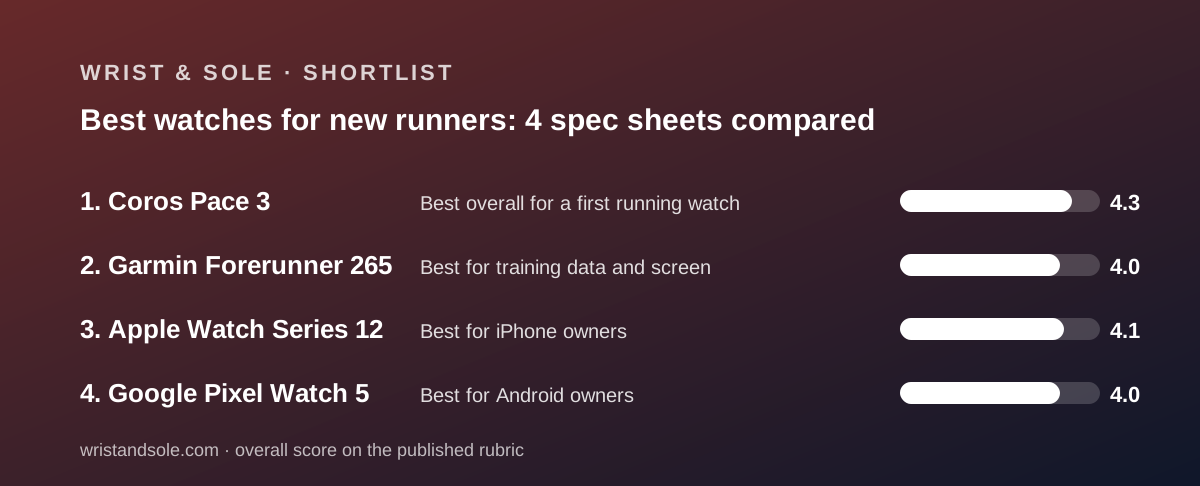
Four watches, four maker pages, one date. Here is the short list with the reason each one is on it.
- Coros Pace 3 - best overall for a first running watch: $199, 38 h standard GPS, 30 g on nylon, 2-year warranty
- Garmin Forerunner 265 - best for training data and screen: $449.99, 1.3 in AMOLED, 20 h GPS-only, 13 days smartwatch, Garmin Pay
- Apple Watch Series 12 - best for iPhone owners: from $399, 2,000 nits, ECG, up to 10 h outdoor-run GPS, 24 h all day
- Google Pixel Watch 5 - best for Android owners: from $399.99, dual-frequency GPS, 3,000 nits, up to 40 h (45 mm), 8 to 10 h continuous GPS per Google's help center
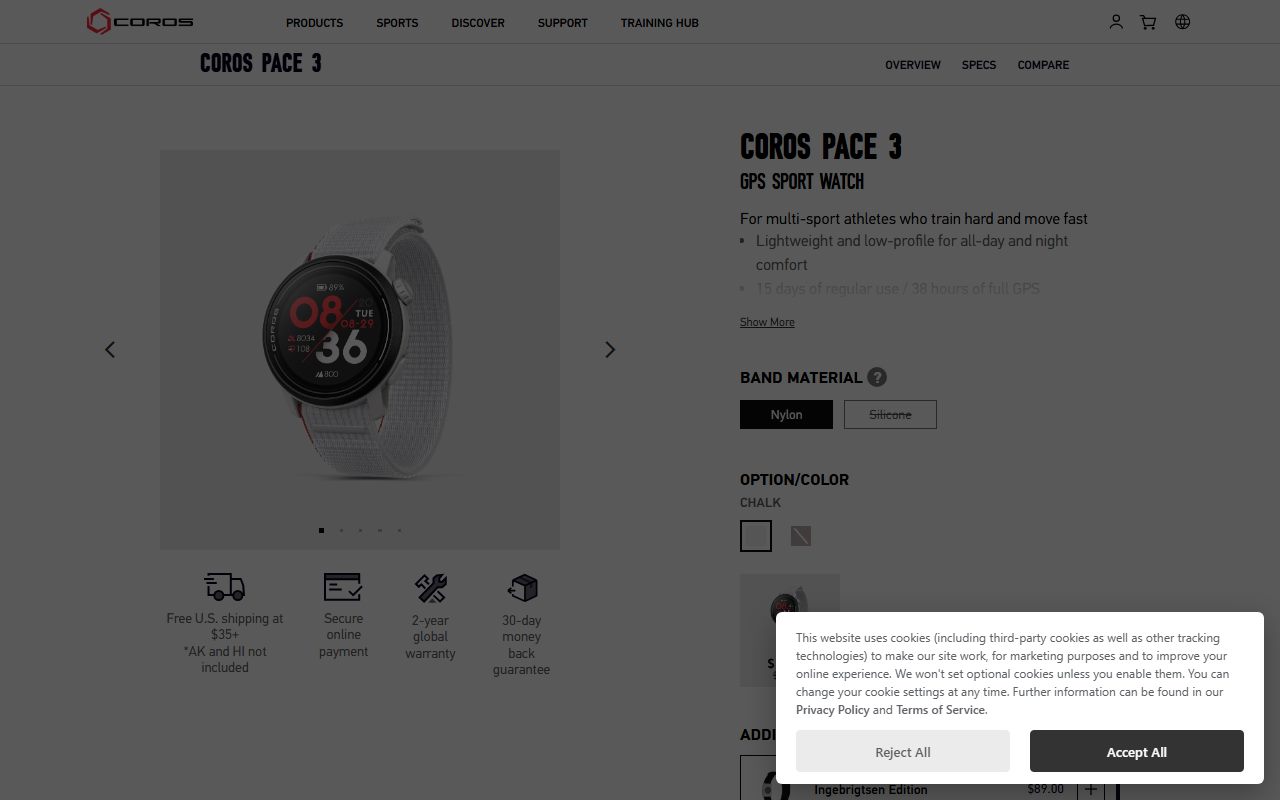
Every figure above comes from the maker's own product, spec or help page on October 17, 2026. Prices are list prices on the maker's US store. Where a maker did not publish a figure, the entry says so rather than borrowing one from a retailer or a search snippet.
- Standard GPS battery: Coros 38 h, Garmin 20 h, Apple up to 10 h outdoor run, Google 8 to 10 h continuous GPS (help center, not model-specific)
- Multi-band or dual-frequency GPS: Coros yes, Garmin yes, Google yes, Apple no (Precision L1)
- Weight: Coros 30 g (nylon band), Apple 32.2 g (42 mm aluminum), Google 31.0 g (41 mm, without band), Garmin 47 g (46 mm)
- Warranty: Coros 2 years from activation; Garmin, Apple and Google 1 year
- Strap: Coros and Garmin 22 mm standard quick release; Apple and Google proprietary connectors
How we picked
We did not run tests of our own; grades come from documentation, pricing pages and warranty text checked on October 17, 2026. Four criteria carried the ranking for a new runner, in this order, with price as the tiebreaker.
- GPS battery for the price. A new runner should not have to think about charging before a long run. We compared the standard GPS hours each maker publishes against the list price.
- Warranty term and wording. A first watch is a test of the habit. We read each warranty for length, start date and battery exclusions.
- Phone fit. A watch that does not pair with your phone is not a choice at all, so Apple and Google entries are labelled by platform.
- Spec transparency. Makers that publish a full battery table, sensor list and strap width ranked above makers that publish less.
We left out accuracy claims. None of the four publishes a GPS or heart rate accuracy figure in meters or beats, so no ranking here rests on accuracy. For how to read the rows we did use, see our watch spec sheet primer.
Why the Coros Pace 3 is the first watch to buy
The Pace 3 wins the two criteria that matter most for a beginner: battery for the price and warranty. Coros lists 38 hours of standard GPS, 25 hours all-systems and 15 hours dual-frequency, plus 15 days of daily use, at $199 with the original $229 struck through.
It also carries the longest warranty in this guide: two years from the original activation date, per Coros's limited warranty. The other three makers publish one year.
The training features cover everything a first plan needs. Coros lists training plans, pre-planned workouts, interval training, a race predictor, VO2 max, training load and recovery in its EvoLab dashboard, with no subscription listed.
The trade-offs are visible on the sheet. The screen is a 1.2-inch, 240 x 240, 64-color memory LCD behind mineral glass. Accessories pair over Bluetooth only. There is no payment feature listed and no map layer, only breadcrumb navigation. Read the full Coros Pace 3 review.
Why the Garmin Forerunner 265 is second
The Forerunner 265 has the most complete running spec sheet of the four, and loses first place on price and warranty alone. Garmin lists $449.99 for the 46 mm model, its 2023 launch price, unchanged on October 17, 2026.
What the extra $250.99 over the Coros buys is listed: a 1.3-inch 416 x 416 AMOLED behind Gorilla Glass 3, 8 GB of storage, Wi-Fi, ANT+ and Bluetooth sensor pairing, Garmin Pay, PacePro course pacing and training readiness.
Battery is strong but behind the Coros: 20 hours GPS-only, 16 hours SatIQ, 14 hours all-systems plus multi-band, and up to 13 days in smartwatch mode. The warranty is one year and excludes consumable parts such as batteries unless a defect caused the failure.
For a beginner, the Garmin is the watch to grow into rather than the watch to start with. Read the full Garmin Forerunner 265 review, and if you are deciding between the top two, our Garmin Forerunner 265 vs Coros Pace 3 comparison goes row by row.
Why the Apple Watch Series 12 is third
The Series 12 is the right watch for a new runner who owns an iPhone and wants one device, and the wrong watch for anyone else. Apple's store listed it from $399 for the 42 mm aluminum GPS model and $449 for 46 mm on October 17, 2026.
It publishes the strongest health sensor set in this guide alongside Google: an electrical heart sensor for ECG, blood oxygen and temperature sensing. Apple publishes 2,000 nits peak brightness, 50 m water resistance under ISO 22810:2010 and a 32.2 g aluminum 42 mm case.
Running battery is where it ranks below the sports watches. Apple lists up to 10 hours of outdoor-run workout tracking, up to 24 hours of normal use and 38 hours in Low Power Mode. GPS is Precision L1 only, the one watch here without a multi-band mode.
It requires an iPhone 11 or later on iOS 27 and uses a proprietary band connector. The warranty is one year. Read the full Apple Watch Series review.
Why the Google Pixel Watch 5 is fourth
The Pixel Watch 5 is the Android equivalent of the Apple pick, with two stronger running rows and a weaker battery. Google listed it from $399.99 for 41 mm and $429.99 for 45 mm on October 17, 2026.
Its strengths are dual-frequency GPS across GPS, Galileo and GLONASS, and a screen rated up to 3,000 nits, the highest published figure in this guide. It is rated 5 ATM and IP68.
It ranks last on the battery criterion. Google's product pages publish all-day figures of up to 30 hours (41 mm) and 40 hours (45 mm) with always-on display, and its Pixel Watch Help Center states 8 to 10 hours with continuous GPS. The warranty is one year, and Google's water footnote states that liquid damage voids it.
It pairs only with Android 12 or newer, and adaptive coaching requires Google Health Premium after a three-month trial. Read the full Google Pixel Watch review.
How to choose a first running watch
Start with your phone. If you own an iPhone and want messages and payments on the wrist, the Apple Watch is the only all-in-one choice here. If you use Android and want the same, the Pixel Watch is. If you only want to record runs, both sports watches pair with either phone.
Then look at GPS hours, not all-day hours. A smartwatch rated at 40 hours of mixed use may log far fewer hours of GPS. Coros and Garmin publish GPS hours by mode; Apple publishes an outdoor-run figure; Google publishes a general help-center range.
Check the warranty start date and exclusions. Coros starts its two years at activation. Garmin excludes batteries unless defective. Google voids its warranty for liquid damage.
Check the strap. Coros and Garmin use 22 mm quick-release straps, so cheap replacements fit. Apple and Google use their own connectors.
Finally, ignore features you will not use in the first six months. Payments, LTE and music are conveniences; pace, distance, heart rate and a plan are what build the habit.
Small wrists: every pick has a published fit range
All four makers publish wrist fit ranges, so a buyer with a small wrist can check before ordering rather than guess.
- Coros Pace 3: one 41.9 mm case; nylon band 135 to 205 mm (long 150 to 235 mm), silicone 130 to 215 mm
- Garmin Forerunner 265: 46.1 mm case with a 135 to 205 mm strap; the 42 mm Forerunner 265S is a size option on the same page
- Apple Watch Series 12: 42 mm case fits 130 to 200 mm wrists, 46 mm fits 140 to 245 mm, per Apple
- Google Pixel Watch 5: 41 mm with small (130 to 175 mm) and large (165 to 210 mm) bands in the box; 45 mm with 150 to 185 mm and 165 to 215 mm
Weight follows size. The lightest published figures are the Coros at 30 g on nylon and the 41 mm Pixel Watch at 31.0 g without its band. The 46 mm Garmin is the heaviest at 47 g. We do not grade comfort, since none of the four was worn for this guide.
Water ratings: all four survive rain and a pool, none is a dive watch
Every pick is rated for swimming-pool depths, and none is built for diving. The wording differs by maker.
Coros and Garmin rate their watches 5 ATM. Coros adds that the Pace 3 suits surface water activities, not diving. Google rates the Pixel Watch 5 at 5 ATM and IP68, for shallow water only, and its footnote states that liquid damage voids the warranty. Apple rates the Series 12 to 50 m under ISO 22810:2010 with IP6X dust resistance.
For a runner, the practical question is sweat and rain, which all four ratings cover on paper. If you want a watch that goes deeper, the 200 m Citizen Promaster diver is the dive-rated option on this site, though it records no runs.
Subscriptions: only one pick asks for one
Three of the four list no paid tier for the features on their spec sheets. Coros lists training plans and EvoLab metrics in its free app. Garmin sells a Connect+ tier, but nothing on the Forerunner 265 spec list is gated behind it. Apple lists no subscription for workout tracking.
Google is the exception. Its overview page says adaptive coaching built with Gemini requires Google Health Premium. The Pixel Watch 5 includes three months, and the store footnote says the trial renews at $9.99 a month unless cancelled.
Buy shoes before you buy a watch
For a new runner, the shoe matters more than the watch, and it costs less. A watch records the run; a shoe that fits is what lets you keep running.
Our best daily trainers for new runners guide ranks four on their brand spec sheets, with prices from $150 to $170 as of October 16, 2026. The Brooks Ghost leads on width options and a 90-day return window that allows running; the Hoka Clifton is the lighter, rockered alternative. Our Brooks Ghost vs Hoka Clifton comparison sets them side by side.
Editorial arithmetic: a Coros Pace 3 at $199 plus a Brooks Ghost at $150 comes to $349, still $100.99 below a Garmin Forerunner 265 on its own.
If you are buying shoes online for the first time, our guide to sneaker sizing, width letters and returns explains what B, D, 2E and 4E mean and how return windows differ.
Bottom line
For a first running watch, the Coros Pace 3 is the pick on the documents: 38 hours of standard GPS, 30 g, a two-year warranty and $199.
Choose the Garmin Forerunner 265 if you want the AMOLED screen and payments and will pay $449.99. Choose the Apple Watch Series 12 if you own an iPhone and want one device. Choose the Google Pixel Watch 5 if you use Android and want the same.
Whichever you choose, put the shoes first. This guide was last checked October 17, 2026, and will be updated in place when any of the four makers changes a price, a battery figure or a warranty.
Also compared
Coros Pace 4 and Pace 4 Pro. Listed in Coros's product menu on October 17, 2026 as newer models; their pages were not read for this guide.
Garmin Forerunner 165. Listed at $249.99 on Garmin's running category page; its product page was not read for this guide.
Garmin Forerunner 570. Sits above the 265 in Garmin's running range; its product page was not read for this guide.
Casio G-Shock GA2100. $110 and 200 m water resistance, but it records no runs; reviewed separately as an everyday watch.
Best overall for a first running watch: Coros Pace 3
Top pick on our rubric. $199 (was $229) on coros.com, 38 hours of standard GPS, 25 hours all-systems and 15 hours dual-frequency, 15 days of daily use, 30 g on the nylon band and a 22 mm standard strap. Two-year warranty from activation, the longest in this guide. Training plans, race predictor and recovery metrics with no subscription listed. The screen is a 240 x 240, 64-color memory LCD, and there are no payments or maps.
Wins battery for the price and warranty outright; loses only on screen and extras.
Visit Coros Pace 3
We have no affiliate relationship with this vendor. Link goes to the official site.
Best for training data and screen: Garmin Forerunner 265
$449.99 for the 46 mm model, with a 42 mm 265S on the same page. 1.3-inch 416 x 416 AMOLED behind Gorilla Glass 3, 20 hours GPS-only, 14 hours multi-band, 13 days smartwatch mode, 8 GB, ANT+, Wi-Fi and Garmin Pay. 22 mm standard strap. The warranty is one year and excludes the battery unless a defect is shown.
The most complete spec sheet, but $250.99 more than the Coros with half the warranty term.
Visit Garmin Forerunner 265
We have no affiliate relationship with this vendor. Link goes to the official site.
Best for iPhone owners: Apple Watch Series 12
From $399 for the 42 mm aluminum GPS model, $449 for 46 mm. 32.2 g, 2,000 nits, 50 m water resistance, ECG, blood oxygen and temperature sensing. Up to 10 hours of outdoor-run GPS, 24 hours normal use, 38 hours Low Power Mode. Precision L1 GPS only. Requires an iPhone 11 or later on iOS 27. One-year warranty.
Best all-in-one for iPhone owners; ranks below the sports watches on GPS battery and band choice.
Visit Apple Watch Series 12
We have no affiliate relationship with this vendor. Link goes to the official site.
Best for Android owners: Google Pixel Watch 5
From $399.99 for 41 mm, $429.99 for 45 mm. Dual-frequency GPS (GPS, Galileo, GLONASS), up to 3,000 nits, 5 ATM plus IP68, ECG-compatible sensors, SpO2 and skin temperature. Up to 30 or 40 hours with always-on display; Google's help center gives 8 to 10 hours of continuous GPS. Android 12 or newer only. One-year warranty, voided by liquid damage per Google.
Better GPS and screen than the Apple pick, but the shortest published GPS battery in this guide.
Visit Google Pixel Watch 5
We have no affiliate relationship with this vendor. Link goes to the official site.
How we chose
We read each maker's official product page, spec sheet, store page and warranty text with a full browser on October 17, 2026, and recorded price, case size, weight, display, water rating, GPS systems and battery by mode, sensors, strap type and warranty. The ranking for a new runner weighs GPS battery for the price, warranty term and wording, phone fit and spec transparency, in that order, with price as a tiebreaker. We did not run with any watch. Where a maker did not publish a figure, the entry says so.
Frequently asked
What is the best watch for a new runner?
On the spec sheets, the Coros Pace 3: $199, 38 hours of standard GPS, 30 g on the nylon band and a two-year warranty from activation, as of October 17, 2026. It records pace, distance, heart rate and training plans without a subscription.
Do I need a GPS watch to start running?
No. A phone app records pace and distance. A watch adds heart rate, wrist-based pace screens and longer battery for runs without a phone. Spend on shoes first; a $150 daily trainer matters more for a beginner than any watch.
Is an Apple Watch good enough for running?
For runs under about two hours, yes on paper: Apple lists up to 10 hours of outdoor-run GPS, 50 m water resistance and heart rate tracking. It needs an iPhone 11 or later, uses single-band L1 GPS and needs daily charging.
Garmin or Coros for a beginner?
Coros for most beginners: 38 GPS hours against 20, two years of warranty against one, and $199 against $449.99, as of October 2026. Choose the Garmin Forerunner 265 for its AMOLED screen, Garmin Pay, 8 GB and ANT+ sensor support.
How much should I spend on a first running watch?
Around $200 buys the Coros Pace 3, the top pick here, with full GPS and training features. Spending $400 to $450 buys a brighter screen and smartwatch features, not more GPS battery: all three higher-priced picks list fewer GPS hours.
Will a running watch work with my phone?
The Apple Watch Series 12 needs an iPhone. The Pixel Watch 5 needs Android 12 or newer. Garmin pairs with either through Garmin Connect. Coros syncs through the COROS app and lists Apple Health among its integrations.