 Wrist
Best trail running shoes for a first trail
We read four trail shoe spec sheets on October 30, 2026 and recorded every figure the brand printed. The Saucony Peregrine 16 is our pick for a first trail at $150.00, and the cheapest two cost $145.00.
Our picks
- Best overall for a first trail: Saucony Peregrine 16
- Best for rough, rocky ground: Merrell Agility Peak 6
- Best for hikers and zero drop: Altra Lone Peak 9
- Best for wide feet in every size: Topo Terraventure 5
The best trail shoes for a first trail at a glance
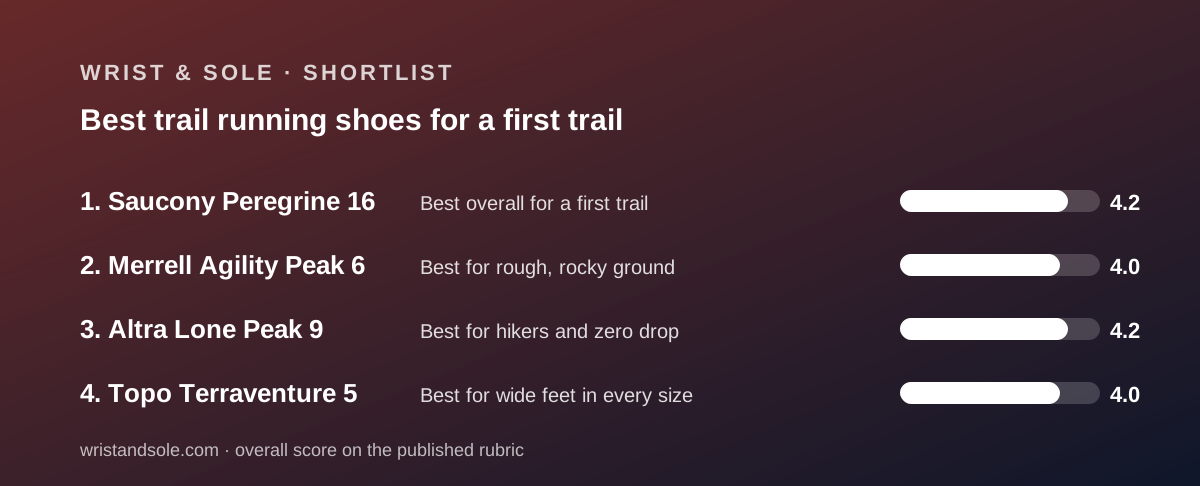
Four shoes, four brand pages, one date. Every figure below was read on October 30, 2026 from the brand's own site.
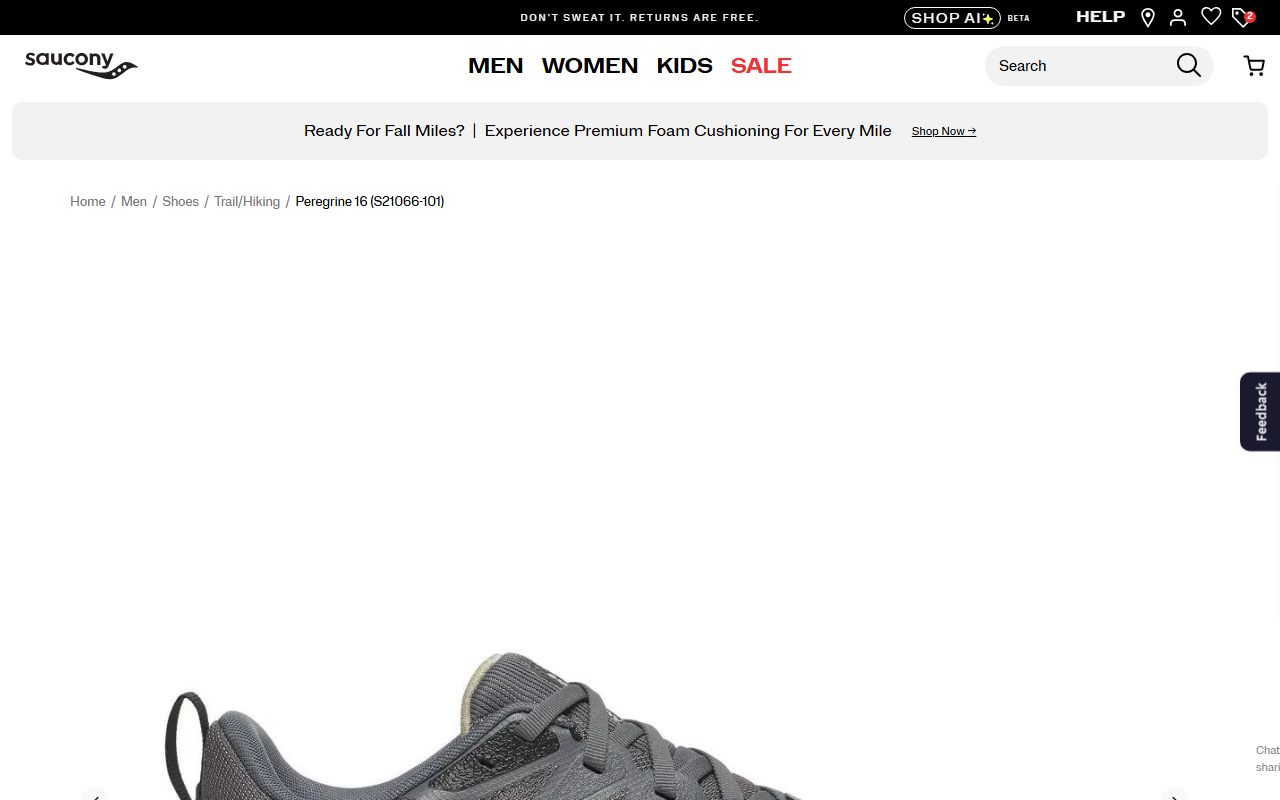
- Saucony Peregrine 16 - best overall for a first trail: $150.00, 4 mm offset, 32/28 mm stack, 4 mm lugs, 9.5 oz, 4.3 from 85 ratings
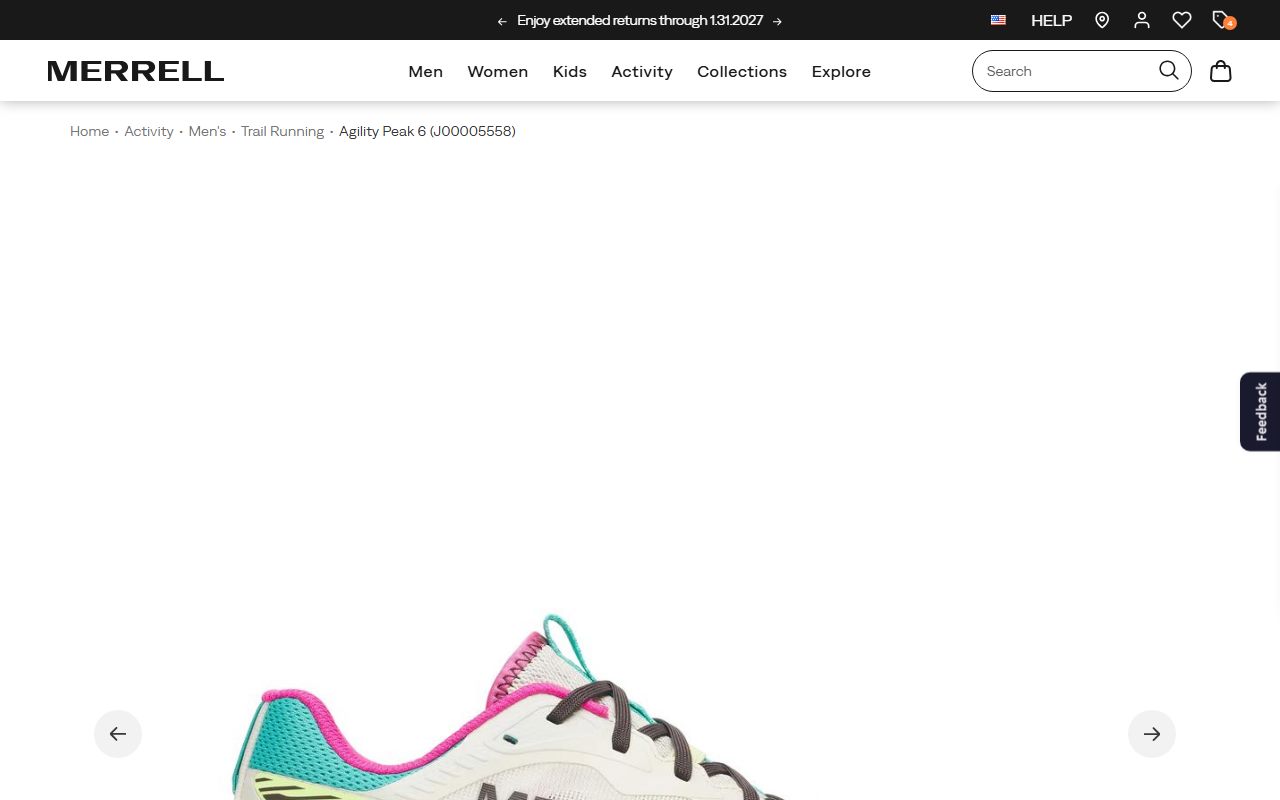
- Merrell Agility Peak 6 - best for rough, rocky ground: $160.00, 8 mm drop, 38/30 mm stack, 5 mm lugs, rock plate, about 10.1 oz
- Altra Lone Peak 9 - best for hikers and zero drop: $145.00, 0 mm drop, 25 mm stack, lug depth not published, 11.15 oz, worn returns allowed
- Topo Terraventure 5 - best for wide feet in every size: $145.00, 3 mm drop, 25/22 mm stack, ESS rock plate, 10.3 oz at M9, worn returns allowed
All four publish a stack height, which no road shoe page we have read does. Only two publish a lug depth. Only one publishes the size it weighed its shoes at, and it is not the one we picked first.
If you want the two best-documented shoes set against each other row by row, read our Saucony Peregrine 16 vs Merrell Agility Peak 6 comparison.
A trail shoe is a different purchase from the road shoe you already own
The first thing to understand is that trail pages publish more than road pages do, and the extra rows are the whole point of the category.
Every road trainer we have read, including the Brooks Ghost 18, the Hoka Clifton 11 and the New Balance 1080v15, publishes a drop and a weight and stops there.
Not one of them prints a stack height. All four trail shoes in this guide do, and two of them also print a lug depth in millimetres.
That is not generosity. It is because trail buyers ask about ground contact and rock protection, and those questions cannot be answered with a drop figure alone.
Our primer on reading a running shoe spec sheet covers the rows in order. For trail, four of them do most of the work.
The four spec rows that decide a first trail shoe
- Lug depth. Measured in millimetres, this is the only hard grip number any brand prints. Merrell publishes 5 mm, Saucony 4 mm, and Altra and Topo publish nothing at all
- Stack height. How much foam sits between foot and ground, written as heel and forefoot. It ranges from 25 mm to 38 mm at the heel across these four shoes, which is a wider spread than the whole road category
- Drop. The difference between those two numbers. Here it runs from 0 mm to 8 mm, so changing trail shoes can change your geometry more than changing road shoes does
- Rock plate. A stiff layer against stone bruising. Merrell and Topo state one; the Saucony and Altra pages we read do not mention one, which we treat as an absence on the page rather than a denial
A fifth row matters and almost nobody prints it: the size the shoe was weighed at. Only Topo does, which is why its 10.3 oz is the one weight in this guide you can compare to your own pair.
The weight comparison nobody can make properly
Three of these four brands print a weight and refuse to say which size they weighed. That single omission makes the whole column soft.
In men's, the published figures are 9.5 oz for the Saucony, about 10.1 oz for the Merrell, 10.3 oz at M9 for the Topo and 11.15 oz for the Altra.
In women's they are 8.08 oz for the Merrell, 8.4 oz for the Saucony, 8.4 oz at W7 for the Topo and 9.3 oz for the Altra.
Notice that the order changes between genders. The Merrell is the heaviest men's shoe but the lightest women's one, which is only possible because the two samples were different sizes.
Topo is the only brand here that closes the gap, by stating M9 and W7. Its 10.3 oz is therefore the one weight in this guide that means a fixed thing.
Merrell manages to publish two weights for the same shoe on the same page: 10.12 oz in the spec panel and 10.05 oz in the bullet list. We print both and pick neither.
Practical advice: treat a weight with no reference size as a ranking hint and nothing more. Weigh the pair you buy if the number matters to you.
What the waterproof versions cost, and whether to bother
Three of these four shoes have a waterproof sibling and the surcharge is consistent. The Peregrine 16 GTX is $180.00 against $150.00, and the Agility Peak 6 GORE-TEX is $185.00 against $160.00.
That is $30.00 and $25.00 respectively, by our arithmetic from list prices read on the same day. Altra lists GTX and waterproof mid versions of the Lone Peak 9 whose prices we did not record.
Neither brand publishes a weight for its waterproof version, so the usual penalty for a membrane is not quantified on either page.
Topo takes the opposite approach on the standard shoe. Its FKT insole is a closed-cell beaded foam that Topo says keeps water out and lets the shoe drain quickly, which is a drainage argument rather than a membrane one.
For a first trail shoe we would skip the membrane. It costs more, it is harder to dry once water gets in over the collar, and no brand here will tell you what it adds in weight.
Returns and warranty vary more between these brands than the shoes do
All four brands offer a 30-day window. Two of them let you run in the shoe first and two do not, and that is the biggest practical difference in this guide.
Saucony and Merrell both accept returns of unworn merchandise only, with free return shipping and free exchanges. A shoe that has been on a trail is outside both policies.
Altra's 30-Day Trial Runs notice and Topo's 30 Day Risk-Free Trial both invite the opposite. Altra limits its policy to customers in the United States and Canada; Topo pays return shipping with a prepaid FedEx label.
Both of those policies carry an abuse clause. Altra may require proof of purchase and reject suspected fraud; Topo may withdraw the policy from customers it identifies as abusing it.
On warranty the pattern reverses. Saucony and Merrell both state one year from the verified date of purchase against defects in materials and workmanship, both signed by Wolverine World Wide, their shared parent.
Altra states one year on manufacturing defects and pays approved claims as an electronic gift card rather than cash. We could not find a stated warranty period on Topo's product page, returns page or promise page.
Every one of those warranties excludes normal wear and tear, which on a trail shoe does most of the work. Our note on when to replace running shoes explains where the line usually falls.
Also compared: four shoes we could not document, and why
We shortlisted seven trail shoes and dropped three because the brand's own site would not open. We name them rather than quietly omitting them.
The Hoka Speedgoat was our first candidate. On October 30, 2026 hoka.com returned an Access Denied page for the men's trail category and for a product URL that had loaded for us earlier in the month.
The Brooks Cascadia 19 was the second. Its men's product page and the Brooks trail listing both returned Access Denied, on a site that was readable on October 21, 2026 when we reviewed the Brooks Adrenaline GTS 25.
The Salomon Speedcross was the third. salomon.com returned a captcha page titled Access to this page has been denied.
We also tried two brands already in our running section. The ASICS men's trail category returned Access Denied, and the New Balance trail listing returned an error page reading Oops, something went wrong.
None of those is a verdict on the shoes. It means we had no first-hand source for their numbers on the day, and we will not take a stack height from a retailer listing or a review site.
One more shoe changed identity mid-search. The Merrell Agility Peak 5 page now returns a not-found notice pointing buyers to the Agility Peak 6, which is why this guide covers the 6.
How to choose: four questions to answer before you order
Can you try the shoe on? If not, the two shoes with a worn-return policy are the safer purchase, regardless of their specifications. That is the Altra and the Topo.
What is the drop of the shoe you run in now? If it is 8 mm or 10 mm, the Merrell is the smallest change. Going from a 10 mm trainer straight to the Altra's 0 mm is a change of training.
How rough is the ground, honestly? Merrell publishes a three-step scale and calls this shoe Rugged. On smooth fire roads you are paying for protection you will not use and carrying the weight of it.
Is your foot wide, or long? Topo lists every size in Standard and Wide on one page. Altra reaches a men's 16. Saucony and Merrell both send a wide foot to a separate style number.
If the answer to all four is that you mostly run on road and occasionally on a path, buy a road shoe instead.
Our daily trainers guide covers four of them on the same terms, and the Brooks Ghost vs Hoka Clifton comparison is the shortest way to a decision.
What we did not grade
We did not grade ride, grip in use, durability or comfort, because grading those requires running in the shoes and we did not.
We also could not read written owner reviews on three of the four pages. Saucony, Merrell and Altra all showed an aggregate rating without rendering review text when we loaded them.
Topo was the exception, and it is the only entry in this guide where we can report what owners actually wrote rather than only what they scored.
Fit is the other thing no spec sheet carries. Our note on sneaker sizing and width letters explains why a width letter means different things by gender and by brand.
Bottom line
For a first trail shoe, buy the Saucony Peregrine 16 at $150.00. It publishes more of what you need to know than anything else at the price, and its brand rating is the highest of the four.
Buy the Merrell Agility Peak 6 at $160.00 if your ground is rocky and you want a stated rock plate and 5 mm lugs, and accept that its page gives two different weights.
Buy the Altra Lone Peak 9 at $145.00 if you hike more than you run, want a 0 mm drop, or need a men's 15 or 16.
Buy the Topo Terraventure 5 at $145.00 if you need a Wide fitting in an unusual size, and use its own 30-day trial rather than guessing, because its owner verdict is split.
If you want the tracking side of this rather than the footwear side, our watches for new runners guide covers the four units we have read, and the COROS PACE 3 is the cheapest of them.
Best overall for a first trail: Saucony Peregrine 16
Top pick on our rubric. $150.00, a 4 mm offset over a published 32/28 mm stack, 4 mm lugs, a full-coverage Vibram Megagrip outsole, PWRRUN foam and 9.5 oz men's or 8.4 oz women's.
It wins because it prints the row the others hide. Stack height, offset, lug depth and outsole compound are all on one panel, and the brand rating is the highest of the four at 4.3 from 85 men's ratings.
The costs are a single width on this style, with Wide sold as a separate page at the same price, and a 30-day window that only accepts unworn shoes. Two spec rows, Traction and Cushioning, were blank when we loaded the page.
Visit Saucony Peregrine 16
We have no affiliate relationship with this vendor. Link goes to the official site.
Best for rough, rocky ground: Merrell Agility Peak 6
$160.00, an 8 mm drop over 38/30 mm, 5 mm lugs, Vibram Megagrip, FloatPro foam and a stated flexible rock plate. Merrell rates the shoe Rugged, the top step of its own published three-step trail scale.
It sits second rather than first because its page argues with itself. The spec panel says 10.12 oz and 38/30 mm; the bullet list on the same page says 10.05 oz and a flat 38 mm.
It is also the most expensive of the four, the heaviest in men's, and its size run skips 12.5. Pick it when the terrain genuinely earns the word Rugged, and check the weight yourself.
Visit Merrell Agility Peak 6
We have no affiliate relationship with this vendor. Link goes to the official site.
Best for hikers and zero drop: Altra Lone Peak 9
$145.00, a 0 mm drop over a 25 mm stack, Altra EGO midsole, MaxTrac outsole and 11.15 oz men's or 9.3 oz women's. Sizes run US 7 to 16 with Regular and Wide in the same grid.
It is third because of one absent number and one heavy one. Altra publishes no lug depth anywhere we could read, and the men's weight is the highest of the four.
It is first on two things that matter to a first buyer. It is the only shoe here that may be run in and still returned inside 30 days, and it carries the largest owner sample at 184 men's ratings.
Visit Altra Lone Peak 9
We have no affiliate relationship with this vendor. Link goes to the official site.
Best for wide feet in every size: Topo Terraventure 5
$145.00, a 3 mm drop over 25/22 mm, a named flexible ESS rock plate, a Vibram outsole, gaiter compatibility and 10.3 oz at a stated size M9. Every size from US 7 to 15 is listed in Standard and in Wide.
It is fourth on owner data rather than on specifications. Topo's page showed 3.8 out of 5 from 38 ratings and 62 percent of respondents saying they would recommend it.
It is the only page of the four that states the size it weighed, which makes its weight the most useful figure in this guide. It also allows a worn return, and we found no stated defect warranty on Topo's pages.
Visit Topo Terraventure 5
We have no affiliate relationship with this vendor. Link goes to the official site.
How we chose
We loaded each brand's own men's and women's product pages with a full browser on October 30, 2026.
From each page we recorded price, stack height, drop, lug depth, weight, midsole, outsole, upper, rock plate, sizes, widths, return terms and the owner rating the brand displays.
We then read each brand's returns page and warranty page and recorded the stated term and its exclusions.
We ranked on four things, in this order: how much the brand publishes, how consistent those figures are with each other, how the width and size coverage works, and what the brand's own owners rate the shoe. Price is the tiebreaker.
We did not run in any shoe and we make no claim about ride, comfort or durability. Where a brand did not publish a figure, the entry says we could not read it rather than borrowing a number from a review site.
Where a brand's site refused to load, we say which brand and what the page returned.
Frequently asked
What is the best trail running shoe for a beginner?
On the four brand spec sheets we read on October 30, 2026, the Saucony Peregrine 16 at $150.00 is the best first purchase. It publishes stack height, offset, lug depth and outsole compound, and its brand rating was the highest at 4.3 from 85 ratings.
How much should a first trail shoe cost?
Between $145.00 and $160.00 on the brands' own stores, as of October 30, 2026. Two of the four shoes here list at $145.00, one at $150.00 and one at $160.00. Waterproof versions add $25.00 to $30.00 on top.
Do I need a rock plate in a trail shoe?
It depends on the ground. A rock plate is a stiff layer that resists stone bruising on sharp rock and roots. Merrell and Topo state one on their pages; the Saucony and Altra pages we read do not mention one.
How deep should the lugs be on a trail shoe?
Only two of these four brands publish a figure, so the question is hard to answer from brand data. Merrell publishes 5 mm and Saucony publishes 4 mm. Altra and Topo publish no lug depth at all, which is a real gap on a trail page.
Can I use road running shoes on trails?
On smooth, dry paths, often yes. The difference these pages document is grip and rock protection, not cushioning. If you mostly run on pavement, our daily trainers guide covers four road shoes read on the same terms.
Which trail shoes can I return after running in them?
Two of the four. Altra's 30-Day Trial Runs policy and Topo's 30 Day Risk-Free Trial both accept worn shoes inside 30 days. Saucony and Merrell both accept unworn merchandise only, with free return shipping.
Is a zero-drop trail shoe a good first trail shoe?
Only if the choice is deliberate. The Altra Lone Peak 9 publishes a 0 mm drop against 8 mm for the Merrell. Moving from a 10 mm road trainer to 0 mm changes how the calf and achilles are loaded, which is a training decision.
Why are some popular trail shoes missing from this guide?
Because their brand sites refused to load on October 30, 2026. Hoka, Brooks, ASICS and New Balance all returned an access-denied or error page, and Salomon returned a captcha. We will not take spec numbers from retailers or review sites.